I've been cleaning out old files recently and I ran across an article from February 1, 1990, that I had pulled out of Family Circle magazine. The article, by Sharon Begley, was about things we could do to "make a difference" and "save the Earth." Along with 101 specific suggestions for individuals to take, there was a prediction of what life would be like in 2010. I thought it was rather interesting to see how reality in 2015 compares with the prediction for 2010, actually made in 1990...
"7:30 A.M.: After serving an organic breakfast to her 8-year-old son, Mark, Jessica scrapes the leftovers into the compost chute next to the sink and drops the empty glass juice-bottle into one of the five recycling bins stored in her kitchen closet. She reminds Mark to throw his cloth napkin into the laundry hamper, then adds an apple to his school lunch box. (Jessica doesn't mind the fruit's brown spot because it shows the apple hasn't been treated with pesticides.) Time for school. She applies No. 30 sunblock to herself and Mark. (Because so many ultraviolet rays are reaching the earth through the thinning ozone layer, no one ventures outside without being well-protected.) On her way out the door Jessica grabs the empty floor-cleaner jug and nail-polish bottle to return for refills. Then she unplugs the electric car, which has been recharging overnight, adjusts Mark's seat belt, and away they go."
Jessica - check. Our daughter's name.
Organic breakfast - check. She tries to eat organically whenever possible (and so do we). So eating organically is possible...but hardly something a preponderance of people try to do.
Compost chute in the house?! Fantasy. Both we and Jess do compost, but we scrape stuff into a compost crock that we carry out to the compost pile when it gets full. No automatic composters in the basement.
Glass juice bottle? Fantasy. It's all plastic packaging these days.
5 recycling bins? Thankfully we've moved beyond that and have single stream recycling now! (Although we do have to pay extra for it.)
Cloth napkin? Check. I've been doing that for decades now...and Jess does as well.
No grandkids yet, though, so I don't know about school lunches. I suspect Jess wouldn't be fixing any; she'd be paying for school lunches.
Mandatory No. 30 sunblock? Mixed. Sun screen is available in SPF 30 and even higher. (Was it available in SPF 30 in 1990? I don't remember.)
HAVING to use No. 30 sunblock every time we go outside because of a thinning ozone layer? Not even. YEAH! Something we acted upon and partially solved! Because the nations got together and banned CFCs (chlorofluorocarbons), the ozone layer is doing better than predicted, especially compared to predictions back several decades ago. Yes, it is recommended that we wear sun screen, but we don't have to be paranoid about wearing it every minute we are outside.
Empty floor-cleaner and nail-polish bottles that get refilled? Ah, no.
An electric car? Yup. Jess and Kyle actually have one! And we have 2 Prii. At least, culturally, we have higher mileage vehicle options available, although not that many people, percentage wise, are using them.
Going further.....
"As Mom always said, "Waste not, want not." Those words of wisdom will again be the rule for our famlies to follow 20 years from now when we'll have made significant changes in every aspect of our lives - from how we eat and keep warm to how we shop and drive - to insure that our world becomes, and remains, environmentally sound."
Well, THAT didn't happen. In fact, we waste a lot more now (and a lot more waste is being done consciously), from driving Hummers and big SUVs just to make the point that we can to buying amazing amounts of new clothing to changing our furniture out on a whim so that we can keep our homes looking up to date to buying new electronics every couple years.
"Reforms are already under way. As required by environmental legislation expected to pass Congress this year, utilities will cut emissions of sulfur dioxide 40% by the year 2000 in order to reduce acid rain. Factories may have to capture toxic fumes before they escape up smokestacks. Newspapers may be required to print on recycled paper to preserve virgin timber. Few of us will notice."
Well, I can honestly say that I don't know whether those initiatives went through. Newspapers are dying, although they have been printed on recycled paper with biodegradable inks for a long time now. Sulfur dioxide emissions cut by 40%? I don't know. Capturing toxic fumes before they go up smokestacks? I don't know. Even though I'm pretty environmentally aware, I have to admit to being part of the great masses who haven't noticed about whether these specific things passed. Certainly many similar regulations did pass...and now many of these regulations are being revoked in the name of "freedom".
"...other new laws will hit close to home. Gasoline-powered lawn mowers and lighter fluid for outdoor grills may be banned by 2010 because of the air pollution they generate; instead, we'll plant drought-tolerant ground-covers that don't need mowing and ignite our charcoal with electric starters."
No. Not even close. I don't think they've even worked to make gasoline-powered lawn mowers more energy efficient and less polluting than they were in 1990. Most of us use propane grills now instead of charcoal grills, with or without using lighter fluid. (Is that an improvement or not? I honestly don't know.) And drought-tolerant ground-covers? Ha! People are putting more chemicals than ever on their lawns, they've put in irrigation systems to keep them watered, and many folks now hire services to keep their lawns mowed perfectly. Yeah, we've gone backwards in most of these areas.
"Because almost all of our nation's landfills will be full by the mid-1990's (more than two-thirds have closed since the late 1970's), many throwaway conveniences of today may of necessity be banned by 2010. Say goodbye to disposable razors, plastic microwave-food trays and plastic utensils and cups. Overpackaged products like single-serving cereal boxes wrapped in plastic, and laundry products in elaborate plastic bottles, will also become distant memories. Instead, we will buy one big jug of detergent, then purchase concentrated refills in pouches. Rather than discarding an empty nail-polish bottle, we will carry it back to the store and get a refill. Paper products will come in just one color - brown - but they will be dioxin-free."
Okay, almost none of this has occurred. Dioxin-free paper products? I think that has occurred, because I haven't heard about dioxin in ages. Otherwise, almost everything is the same or worse than it was 1990. More single serving foods. More plastic trays and utensils. More disposable everything.
The major divergence between predicted 2010 and real 2015 continues for the next several sections....
"...virtually all household waste will be recyclable, reusable or compostable..." Ah, ... no.
"The need to make less trash will become the driving force of the 21st-century marketplace." We're moving into the world of farce with this one.
"Farmers too will do their part, and trade in carcinogenic pesticides for such organic remedies as microorganisms and flowers that exude pest-killing chemicals. ...No longer will pesticides running off farmlands pollute [our rivers and lakes]." Cue the maniacal laugh of irony. (At least there IS a growing farmers' market sector developing, much of which is organic.)
But then the divergence starts to get smaller again....
"Chemicals called chlorofluorocarbons (CFC's) will be outlawed because they are responsible for our thinning ozone layer (a band of gas about 15 miles up that blocks skin-cancer-causing ultraviolet rays from the sun). This will mean that egg cartons and trays in meat packages will be made of recycled paper and not foam. We'll also do without typewriter correction fluid and liquid spot remover, which contain ozone-depleting chlorine. To insulate our homes, we will use cellulose foam from recycled wood fiber rather than blown plastic foam. Our home air conditioners will operate on a new, costly chemical that will make staying cool on the road an expensive luxury."
Yup. We nailed this one, although thankfully the "new, costly chemical" for automobile air conditioners wasn't as prohibitively expensive as feared.
"We'll be sacrificing other frills as well to slow the greenhouse effect (the gradual warming of the planet caused by carbon dioxide released when oil, natural gas, wood and coal are burned). To conserve energy and reduce carbon-dioxide emissions, we will install super-efficient three-pane windows with special coatings and fillings of krypton and argon gas that collect more heat during the day than leaks out at night. We will screw in compact-fluorescent lightbulbs that give off the same amount of light as 60-watt incandescents but use only 18 watts of power."
Well, we have much more efficient windows than we did in 1990 and we utilize compact-fluorescent lightbulbs, too. So, good forward motion in these areas.
"Thirty percent of the electricity we'll use to run our energy-efficient appliances in 2010 will be drawn from solar and wind power. To collect sunshine, 1% of our nation's land -a total area about half the size of Arizona - will be covered by solar panels."
Well, we have much more energy efficient appliances than we did in 1990, but we don't get 30% of our electricity from solar and wind yet. On the plus side, 5 years past the predicted day, we're finally moving in the right direction with both these renewable, carbon free, energy sources.
"Even our cars will plug into the sun. (Methanol and natural gas may serve as transitional fuels in the 1990's, but since both contribute to the greenhouse effect, they will not suffice for long.) "We don't have electric cars today because we haven't developed a battery powerful enough to let a car go more than 50 miles or so on a charge," says Dick Klimisch, Ph.D., executive director of environmental activities at General Motors. "By 2010 we might." "
Only now, in 2015, is battery technology starting to move forward. It took an auto industry outsider, Tesla, to move us forward in that regard. Unless the currently cheap gas prices derail the research and new technology, our fleet mileage should be increasing significantly in the next decade or so.
The article concludes with a paragraph that still rings true, if you adjust the decades a bit. (We keep hoping we'll avoid the pain...but, as most of us know deep inside, usually you have to just go through the painful times to come out okay on the other side.)
"Yet for all we do, we can't reverse some of the abuse we've waged on this earth. There is no way to stop chemicals already emitted from eating away at the ozone layer. Greenhouse gases already aloft will warm the world, so storms like last year's Hurricane Hugo will be more intense, as will torrid summers like the sweltering one of 1988. "No matter what we do," say EDF's Oppenheimer, "we're in for about a decade of acid rain, serious air pollution, additional warming and ozone depletion." But if we can survive the 1990's, the 21st century might be livable. We can shape the future, IF we start today."
Oh, we're shaping the future, all right. For the most part, we're too scared of moving through the necessary pain to shape the future in a way we'll be happy about in the next 20 years. What will 2035 bring?
Showing posts with label Politics. Show all posts
Showing posts with label Politics. Show all posts
Friday, January 30, 2015

Thursday, April 03, 2014
Thoughts Provoked By Trash

When I fished the trash out to throw it away, though, something made me look at it a little more closely - and for a brief moment I got really mad. Seriously - have we become so crunched for time (or simply lazy) and so consumerized that it is necessary to buy peanut butter and jelly sandwiches premade and pre-packaged??? Peanut butter and jelly sandwiches? Really?

When we've gotten to the point where we're too busy or stretched too thin to get ourselves a glass of water from the faucet or to make our children a peanut butter and jelly sandwich, we're too busy. Something's got to give.
It takes 2 people to earn a living these days. If even 2 people can. Working 40 hours each, 50 hours each, 60 hours each. Working hard, because we'd never want to be seen as slackers and because we have no choice. Performing "internships" for free so that we can get experience, then not getting hired because the next unpaid intern is waiting, anxious to work for "experience." Working 2 jobs at 35 hours each so that the companies don't have to pay benefits - we're "part-timers" working 70 hours each week but not "worth" health insurance or paid time off or sick leave. When these horrible hours have their inevitable result and our bodies rebel, we become one of the "slackers", too sick to keep working. If our health insurance comes from our employer, we're really screwed. Too sick to work, but no health insurance if we're not working...and no work to get money to pay for health insurance.
We're not machines. Any of us. We're human beings, with good points and with faults, with weaknesses and with strengths. Some of us are kind and some of us aren't. Some of us naturally work harder than others. Some of us are smarter than others. Some of us are more social or less social than others. Caring - or not. Artistic - or not. Creative - or not. Neat - or not. One way or another, there's much more to human life and human worth than paid labor. And it's time for us - all of us - to remember that. We need to be treated as living humans, to treat each other as worthwhile humans, and to treat ourselves with love and compassion. We need to take our lives and our world back. One way...or another.
Tuesday, September 03, 2013
(Warning!) Rant: Too Much is Too Much
(Note: this isn't a gardening post!)
How much is too much?
My mother-in-law passed along several issues of Architectural Digest last week and, for kicks and giggles, I started thumbing through them over the weekend. One article, in particular, has stuck with me, raising my blood pressure every time I think about it.
A husband owns a business, geological services, in New Orleans. He wants to move his business (and family) to Houston. His wife sees a home there, which hasn't been lived in for some time, and tells him that if he'll buy that home, she'll move.
He buys the home. It's a large mansion on 4 acres, completed originally in the early 1930's. Of course there are repairs and updates and remodeling to do: plumbing, wiring, heating, cooling, a new roof, bigger closets, a bigger kitchen, a family room, a conservatory....
Among those more normal things, which any well-to-do family buying an older home would want and expect to do, here is a list of things they've done in the last 14 years that were touted in Architectural Digest:
1. Reopened a closed quarry to mine limestone, so that they could exactly match the limestone on the outside of their home, during expansions, with the limestone used by the original architect/builder.
2. Had their decorator go on buying trips to New York, Los Angeles, and Paris, often with them accompanying her. They have found (and used in their home) a huge chandelier once owned by Napoleon III, 16th century Italian painted ceiling panels, a 17th century Brussels tapestry (in the wine cellar) and a "museum quality" 18th century Italian mirror - among many, many other beautiful pieces of antique and more modern furniture.
3. Installed an antique chapel - imported from France - adding an 18th century chandelier and 19th century stained glass windows and pews to it.
4. Imported (from France) the antique cobblestones with which they surfaced the driveway.
Am I jealous? Believe it or not, no. As I've gotten older, I've learned that the more I have, the more I have to take care of, in one way or another. I'm finding that simpler is better, at least for me, personally.
What is infuriating to me is that this is a "relatively ordinary" rich couple who is doing this. This isn't a mogul whose name is on all our lips. These aren't the Rockefellers or Carnegies or Hearsts. These folks aren't someone particularly special or unique right now. And they can afford to do this (and ARE doing this) in a time when poverty is climbing, jobs are scarce, and the middle class - those poor blokes who just want to be able to own a 1200 square foot house on a 0.1 acre lot somewhere - are being squeezed out of existence.
Is the house gorgeous? Oh, my, yes. However, as beautiful as this house is and as special as the activities are that has brought it into this sort of condition - I have a real problem with having an entire class of people who are able to do this in our "egalitarian" country. Should people be rewarded for hard work and initiative? Definitely. But there needs to be a limit to those rewards, a limit that is reached before the level of, literally, living like kings. I don't think our Founding Fathers were trying to establish an economic aristocracy when they revolted from England.
How much is too much?
My mother-in-law passed along several issues of Architectural Digest last week and, for kicks and giggles, I started thumbing through them over the weekend. One article, in particular, has stuck with me, raising my blood pressure every time I think about it.
A husband owns a business, geological services, in New Orleans. He wants to move his business (and family) to Houston. His wife sees a home there, which hasn't been lived in for some time, and tells him that if he'll buy that home, she'll move.
He buys the home. It's a large mansion on 4 acres, completed originally in the early 1930's. Of course there are repairs and updates and remodeling to do: plumbing, wiring, heating, cooling, a new roof, bigger closets, a bigger kitchen, a family room, a conservatory....
Among those more normal things, which any well-to-do family buying an older home would want and expect to do, here is a list of things they've done in the last 14 years that were touted in Architectural Digest:
1. Reopened a closed quarry to mine limestone, so that they could exactly match the limestone on the outside of their home, during expansions, with the limestone used by the original architect/builder.
2. Had their decorator go on buying trips to New York, Los Angeles, and Paris, often with them accompanying her. They have found (and used in their home) a huge chandelier once owned by Napoleon III, 16th century Italian painted ceiling panels, a 17th century Brussels tapestry (in the wine cellar) and a "museum quality" 18th century Italian mirror - among many, many other beautiful pieces of antique and more modern furniture.
3. Installed an antique chapel - imported from France - adding an 18th century chandelier and 19th century stained glass windows and pews to it.
4. Imported (from France) the antique cobblestones with which they surfaced the driveway.
Am I jealous? Believe it or not, no. As I've gotten older, I've learned that the more I have, the more I have to take care of, in one way or another. I'm finding that simpler is better, at least for me, personally.
What is infuriating to me is that this is a "relatively ordinary" rich couple who is doing this. This isn't a mogul whose name is on all our lips. These aren't the Rockefellers or Carnegies or Hearsts. These folks aren't someone particularly special or unique right now. And they can afford to do this (and ARE doing this) in a time when poverty is climbing, jobs are scarce, and the middle class - those poor blokes who just want to be able to own a 1200 square foot house on a 0.1 acre lot somewhere - are being squeezed out of existence.
Is the house gorgeous? Oh, my, yes. However, as beautiful as this house is and as special as the activities are that has brought it into this sort of condition - I have a real problem with having an entire class of people who are able to do this in our "egalitarian" country. Should people be rewarded for hard work and initiative? Definitely. But there needs to be a limit to those rewards, a limit that is reached before the level of, literally, living like kings. I don't think our Founding Fathers were trying to establish an economic aristocracy when they revolted from England.
Thursday, April 11, 2013
Facing Into the Sun
This morning's exercise in photography - trying to capture the beauty of a world encased in ice - provided a philosophical lesson as well as an artistic one: sometimes the only way to see the real truth of a situation is to look directly into the light.
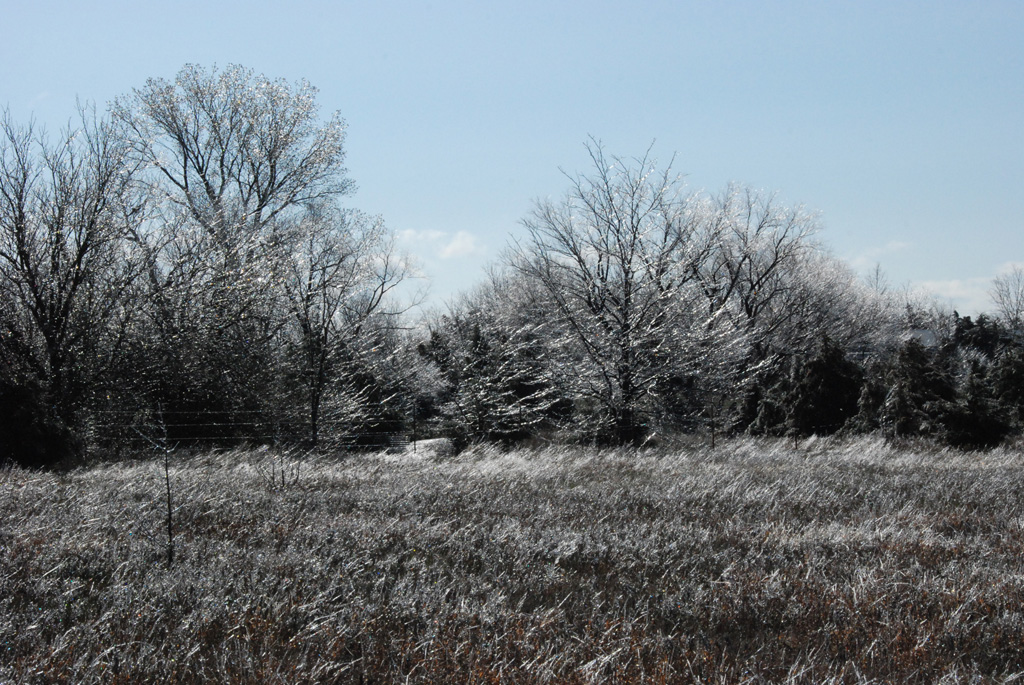 Looking directly at the light can be painful. In fact, it can be blinding. Done correctly, though, it can show us exactly what's going on.
 Looking away from the light can be misleading, making us miss the reality of a situation. The above two photos were taken less than a minute apart, simply by changing the direction that I was aiming the camera. The first picture shows the reality of the ice coating everything. The second photo looks basically normal - you have to look hard to see any evidence that anything is different from a regular spring day.
Moving from ice storms to a broader view of life, this metaphor works well for a "controversial" issue facing our society today: climate change. Truly, there is no scientific controversy concerning this issue. The scientific community is shining the light of their research and knowledge, showing us the reality of climate change. However, too many people are turning away from the information the scientists are providing because it hurts - and, truthfully, it's pretty scary too.
Looking away from the sun this morning, I could hardly tell this wasn't a perfect spring morning but, looking towards the light of the day, I could see that there was a hard layer that was affecting everything.
The Union of Concerned Scientists has been addressing the issue of climate change for some time. Here is an article they shared on Facebook this morning, giving a specific example of how the truth about climate change is being hidden for political reasons: What South Carolinians Deserve to Know About Climate Change.
The National Center for Science Education is another group that has picked up the job of getting scientific information about climate change into the public arena. They, too, had a good article that they shared this morning addressing the issue of climate change, A Denver TV Meteorologist...in His Own Words. This article was actually originally posted by The Yale Forum on Climate Change & The Media.
There are many other groups and individuals trying to share scientific facts, as well as the predictions based upon those facts and upon the best scientific knowledge we currently have about how our Earth's atmosphere works.
There are also those groups and individuals who are afraid they will lose a great deal of economic and political power if climate change is acknowledged and if, as a country, we start to work to keep the worst of those scientific predictions from occurring. Because these latter folks currently DO have a great deal of economic and political power - and money - their views are getting much more attention than they should.
Too many people are looking away from the light of knowledge, into the "pretty picture" that distorts the reality of the situation.
On this issue, as on so many other issues, be very careful where you get your "knowledge". All information is not created equal. Even if it hurts and is frightening, we all need to look at the world through the best light we have available to us, instead of turning our backs to the truth.
Moving from ice storms to a broader view of life, this metaphor works well for a "controversial" issue facing our society today: climate change. Truly, there is no scientific controversy concerning this issue. The scientific community is shining the light of their research and knowledge, showing us the reality of climate change. However, too many people are turning away from the information the scientists are providing because it hurts - and, truthfully, it's pretty scary too.
Looking away from the sun this morning, I could hardly tell this wasn't a perfect spring morning but, looking towards the light of the day, I could see that there was a hard layer that was affecting everything.
The Union of Concerned Scientists has been addressing the issue of climate change for some time. Here is an article they shared on Facebook this morning, giving a specific example of how the truth about climate change is being hidden for political reasons: What South Carolinians Deserve to Know About Climate Change.
The National Center for Science Education is another group that has picked up the job of getting scientific information about climate change into the public arena. They, too, had a good article that they shared this morning addressing the issue of climate change, A Denver TV Meteorologist...in His Own Words. This article was actually originally posted by The Yale Forum on Climate Change & The Media.
There are many other groups and individuals trying to share scientific facts, as well as the predictions based upon those facts and upon the best scientific knowledge we currently have about how our Earth's atmosphere works.
There are also those groups and individuals who are afraid they will lose a great deal of economic and political power if climate change is acknowledged and if, as a country, we start to work to keep the worst of those scientific predictions from occurring. Because these latter folks currently DO have a great deal of economic and political power - and money - their views are getting much more attention than they should.
Too many people are looking away from the light of knowledge, into the "pretty picture" that distorts the reality of the situation.
On this issue, as on so many other issues, be very careful where you get your "knowledge". All information is not created equal. Even if it hurts and is frightening, we all need to look at the world through the best light we have available to us, instead of turning our backs to the truth.
Monday, September 17, 2012
Rachel Carson Still Has Lessons to Teach
This month is the 50th anniversary of the publication of Silent Spring, Rachel Carson's seminal book about pesticides. This single book is often credited with jump-starting the environmental movement during the 1960's. Less than 2 years after Silent Spring was published, Carson herself was dead at the age of 56 from breast cancer. I was 6 when the book was published, and not quite 8 when she died. I'm 56 now....
Last week, I finished reading a lengthy biography about this important woman, Rachel Carson: Witness for Nature, written by Linda Lear and published in 1997. I'd been gnawing away at this fairly hefty book for several weeks. It wasn't a particularly easy read, and parts of it were downright dripping with details that I really didn't think needed to be included. However, over and over again as I read it, I found myself riveted by the path of her life: by her frequent troubles, by her dogged determination, by certain "silver linings" that serendipitously encouraged her along her way. By those who supported her...and by those whom she supported, literally and figuratively. (Note: All information discussed/mentioned below about Rachel Carson and her life was provided by this biography.)
A little personal back story: my 9th grade physical science teacher, Mr. Jack Pylant, encouraged a small cadre of his students to form an Ecology Club during the 1970-1971 school year. We had a blast, making a Super 8 movie about "Captain Ecology: He's Everywhere! He's Everywhere!" that showcased one of our classmates in tights and a cape jumping out of bathtubs and garbage cans, helping teach people how not to pollute in their every day life. We made posters and picketed the local grocery store on the first anniversary of Earth Day. And, during that year, Mr. Pylant had me read Silent Spring.
I'd always been a kid who loved bugs and animals and plants, but this book opened up my eyes to the longterm damage that people were doing to those same bugs and animals and plants - and also to us humans. I never again had a mentor who encouraged my interest in the environment in the way that Jack Pylant did, but I've never forgotten those early lessons in human short-sightedness either.
As I raised our children, I came across Carson's wonderful book, A Sense of Wonder, published (I learned when I read this biography) posthumously. To me, this short book is almost a prayer, asking that all children have at least one adult in their life who has retained their sense of wonder in nature and who will take the time to share the child's delight in the natural world around them. Unfortunately, I think fewer and fewer children have such an adult these days.
So why did I pick up this biography? And what insights did I gain from the life story of a woman who died almost 50 years ago?
I'd bought Linda Lear's biography of Carson shortly after it came out, following my tendency to pick up books of interest when I see them. The problem is that my interests are broader than my time to read about them is long - so, in this case, as in many other cases, I put the book on a bookshelf and left it there, intending to read it "some day."
"Some day" came about in August when I volunteered to give a program about "an influential woman in my life" for my small town sorority's monthly meeting. For some reason, my mind grabbed onto the unread biography sitting on my bookshelf, I announced my intention, and I picked up the book and started to read. Almost a month later, here are the insights (in italics) that are still rattling around in my head....
Rachel Carson didn't have a particularly easy or happy childhood. Her mother Maria was intelligent and well educated for her time, from a family that valued both. Maria was in danger of becoming "an old maid" when she married a man who turned out to be relatively sickly, unlucky, and a poor provider. There is no evidence that Robert Carson valued Maria for her intelligence or her education. Within a few years of marriage, they had two children, a girl and a boy. Eventually moved to a pretty, but hilly, piece of property along the Allegheny River near the burgeoning town of Pittsburgh, Pennsylvania. Soon after the move, and 7 years after the birth of their younger child, Maria had a 3rd child, a little girl they named Rachel. With both of her older children in school, Maria devoted herself to her youngest, roaming the woods of their farm, exploring the natural world together. Maria also shared her love of reading with her children, but it was her youngest, Rachel, who most shared their mother's interests.
At the end of the 1800's and start of the 1900's, there was a large cadre of amateur naturalists, many of them educated, middle class women. Keenly interested in natural history, Maria Carson was part of this cadre. Many of these well educated women wrote books about nature, creating a nature study movement nationwide. In 1911, the Handbook of Nature Study was published by Cornell University that provided methods and actual study guides and lesson plans for non-scientists to teach children about nature. This was a perfect fit for Maria Carson and her young daughter Rachel.
So Rachel grew up loving and knowing nature. She read a great deal and, by age 11, was writing pieces that were accepted by a children's magazine, St. Nicholas, for publication in their monthly children's writing contests.
Rachel had an adult close to her who shared her delight in nature and who encouraged her to read, instilling in Rachel twin passions that would enrich and shape her entire life.
The Carson family farm was rather removed from town and Rachel grew up playing by herself most of the time. Her mother being the overprotective sort, Rachel was also frequently kept home from school if illnesses threatened in town. With her frequent absences, strong love of reading and nature, poor economic situation, rather solitary nature and her close relationship with her mother, Rachel did not fit in very well at school; she had few friends of her own age.
College only emphasized her singularity. Her parents scraped and scraped to send her to college, so the need to do well academically was deeply impressed upon Rachel. Her mother Maria, starved for intellectual stimulation, visited Rachel almost every weekend, staying with her and studying alongside her. This could not have helped her social life in college. Meanwhile, Rachel's 2 older siblings were enjoying a less academic entrance to adult life. Both became rather wild and eventually married young; neither marriage working out well. Rachel's older sister Marion was left with 2 young girls to raise on her own. She moved back in with her parents and Rachel, adding 3 more mouths to an already economically stressed family. Rachel's brother moved in and out of the family home for many years, but never seemed to contribute money or emotional support to the larger family unit. With her parents and her siblings serving as her examples of married life, it is no great wonder that Rachel Carson did not aspire to marriage herself.
Rachel only dated one young man in college, and that was briefly. While she was active socially in her all women's institution, her primary concern was learning. She started in English, planning to be an author, but switched halfway through to science, especially biological sciences. Luckily, Rachel had strong mentors, especially one of her biology professors, who guided her during college and helped her find appropriate work after college, their teacher-student relationship strengthening to a strong friendship that lasted their entire lives.
Although Carson tried hard to continue on with her education after college, enrolling in graduate work at Johns Hopkins, eventually national economic realities interfered. It was the Depression. Rachel's father was ill and couldn't support his wife, eldest daughter and 2 granddaughters adequately. Rachel ended up moving her entire family to be near her in Maryland and took part time work to both help her family economically as well as pay for her graduate work. There seems to have been no regret in leaving the family farm near Pittsburgh. By this time, the pollution generated in that large industrial city had decimated the natural environment of the area. For a lover of nature like Rachel, this rapid destruction of her home's surroundings would have been a tragedy of major proportions, a personal environmental tragedy that would thereafter color her awareness of natural process with an understanding of just how fragile the environment could be in relation to human interference.
Once again living with her family, sharing bills and housekeeping with them, maintaining stable finances continued to be difficult for Rachel, her parents and her sister. However, one of Rachel's part time jobs turned out to be writing radio program scripts for the U.S. Bureau of Fisheries...which eventually morphed into a full time position writing, and eventually into editing. Before she got the full time position with the Bureau, though, her father died, leaving Rachel as the primary economic support for the rest of the household.
Except for the brief 9 month period between college and bringing her family to Silver Springs, Rachel Carson lived with her mother for her entire life, until her mother's death 5 years before her own. Until the last few years, Maria took care of running the household for Rachel, as well as occasionally helping her with her work.
While working part time, Rachel had started freelance writing articles about nature for newspapers and magazines, including the Baltimore Sun and, eventually, the Atlantic Monthly. She was exposed to the most current fisheries research in her job and, loving the sea, would share the information she was learning with the non-scientific public. Eventually she was encouraged to write a book, Under the Sea-Wind, which was released in November, 1941. The critics raved about the book. Carson had found the perfect union of her talents and passions, uniting her love of writing and biology in a career of nature writing.
Once again, however, national events strongly effected her life. With the U.S. being drawn into World War II, there was little money to promote the book of a relatively unknown author. Very few copies of the book sold, its time in bookstores overlapping so thoroughly with a war that completely sapped the time, energy and resources of our entire nation.
Carson, however, persevered. Still working in her spare time, she started work on another book, which eventually became The Sea Around Us, published almost 10 years after Under the Sea-Wind was released. In the intervening 10 years, Carson had widened her circle of friends and professional acquaintances. She had also hired a literary agent. Last, but far from least, Carson had also learned from her previous experience. This book was promoted much more professionally - and it made quite a splash, making it onto the best-seller list and remaining there for 86 weeks.
The popularity of The Sea Around Us was partially due to Rachel Carson's poetic ability to interpret science for the non-scientific reader, but it was also because this was the right book for its time. At a point in history when a great chasm was opening up between most people and the natural world, Carson helped to bridge that chasm in understandable, enjoyable prose. She presented her information in a format that took a long view of time, helping ease people's fears about current events.
Interestingly to those of us used to current standards, Carson's success created a maelstrom of criticism based entirely on her gender. A FEMALE writing a successful, scientific book? Her looks and her persona were the subject of much speculation. At least one high profile interview with Carson, after her book was a strong success, talked more about how she was dressed and what makeup she wore than it did about her academic background or her interest in the sea. This was just 60 years ago. Perhaps it's not surprising that there is still a strong element espousing this view of the world - and frantically trying to recreate their desired reality before it disappears completely into the past.
For the most part, all of this angst simply amused Carson. This second book had allowed her to do something she'd been wanting to do more and more: to quit her job with the U.S. Fish and Wildlife Service so that she could concentrate more completely on her writing and on caring for her mother, who still lived with her and was, at this point, over 80 years old.
The next project that Carson undertook was a guide to the sea shore, connecting the world of The Sea Around Us to the land that most people were more familiar with. Once more Rachel started doing both scientific literature research in libraries and field work along the Atlantic shore to fully understand her topic and to be able to interpret it for her nonscientific audience. Originally scheduled to be completed in two years, it was actually four years until The Edge of the Sea was published, in 1955.
During this time, Carson had many claims on her time. Not only was she researching and writing, as well as caring for her mother, she received several major awards that required both travel and well thought out acceptance speeches. Since she saw these speeches as important opportunities for her to share her love of nature and the environment with others, she always prepared for them carefully. There were magazine articles to write and even the script to a television show. Friends came to visit, often staying for a week or more at a time.
Her family was also claiming more of her time and energy. Rachel was assuming another family burden - her niece, Marjorie, a fragile diabetic, became pregnant unexpectedly and suffered a complicated and dangerous pregnancy. The father of the child being unavailable, this family dilemma became, to a great extent, Rachel's responsibility. Roger was born early in 1952, living with his mother (but both of them spending large amounts of time with Rachel and her mother) until Marjorie died early in 1957, at which time Rachel assumed primary care of the not-quite-5 year old boy.
One of the things Rachel most loved to do on visits with her great-nephew Roger was to explore outside with him, much as her mother had done with her. In 1956 she wrote an article about their times together for the Woman's Home Companion, "Help Your Child to Wonder." She always intended to lengthen this essay and publish it as a book, but that was never to be. The article is the basis for The Sense of Wonder, published posthumously in 1965.
The years of 1956 to 1958 were difficult ones for Rachel Carson, as she tried to combine her writing with caring for her extremely ill niece, her elderly mother, and her young great-nephew. As mentioned, Marjorie died early in 1957. Maria, Rachel's mother, passed away at the end of 1958. Now it was just Rachel and her young grand-nephew left in the household.
Life, of course, rarely gives anyone clear lines of demarcation...or time to grieve. Shortly after Marjorie died, early in 1957, Rachel learned about a new USDA program, trying to eradicate fire ants in the south, that involved the aerial spraying of powerful pesticides over thousands of acres of land. There was even some talk, on the part of government scientists, about such spraying being able to eradicate insects altogether.
Back in 1945, Rachel had learned about DDT through her work with the U.S. Fish and Wildlife Service. The new chemical DDT was used in World War II against lice and insect-borne diseases; after the war, the government and the chemical companies that manufactured DDT were left with large stockpiles of it. Wanting to use this material up, the government decided to release DDT for non-military use. Testing of DDT's toxicity to humans was woefully incomplete; testing of its toxicity in the general environment was even weaker.
The Fish & Wildlife folks decided to run some preliminary tests on DDT's broader effects at their Patuxtent Research facility in Laurel, Maryland. Rachel learned the results of the early tests through her professional colleagues and by editing some of the reports. At the time, she wanted to do an article on DDT for Readers' Digest, but the magazine wasn't interested. Meanwhile, others who learned of the test results likened DDT to the atomic bomb in its ability to create whole scale destruction of "the enemy."
Now, in 1957, not only was this new program to eradicate fire ants being proposed, but DDT mixed with fuel oil was being aerially sprayed over wide areas of the east coast in an attempt to eradicate Dutch elm disease. This lethal mixture was also being widely used in fogging to try to control mosquitoes. In fact, a group of Long Island residents (including Dr. Bejamin Spock's younger sister, Marjorie) had sued the government to discontinue this spraying of their land, in concern for their own personal health. At one point, Spock's garden had been aerially sprayed with this mixture 14 times in a single day. Folks in other areas of the country were watching the Long Island case closely, as their land was being sprayed with the same mixture in an attempt to control gypsy moth and tent caterpillars, as well as mosquitoes.
It wasn't too long before Rachel Carson realized that a book on the subject of these synthetic pesticides and their environmental effects was something tremendously important that she needed to write. By 1958 she had begun work on this project, which essentially took up the remainder of her life.
Once she started this work, all was not smooth, however. First of all were her mother's health issues, culminating in her mother's death at the end of 1958. 1959 was a little better, although research for her book had to compete with care of Roger and with other writing obligations. 1960, however, almost immediately brought with it major health problems. In early January, Rachel was diagnosed with a serious ulcer. By the end of January, she got hit with a serious viral pneumonia, followed by a sinus infection. In March she found several "cysts" in her left breast, which turned out to be cancer. Surgery, which ended up including a radical mastectomy and the removal of multiple lymph nodes, occurred in early April. Under careful questioning, her surgeon assured her that she didn't need any followup treatment because the lumps and nodes he'd removed weren't actually malignant, but just bordered on malignancy.
Roger, now 8 years old, was starting to act up in school, adding another component of stress to Rachel's life. Then, in November, her cancer reoccurred in the form of a hard lump on a rib, and she started radiation treatment. Radiation treatments continued, off and on, for several years, making her feel extremely ill each time. From here on out, Rachel Carson's life feels like a race between finishing her book and dying of cancer.
Despite her seriously bad health (about which she swore those near her to secrecy), Rachel continued on with her research and writing. The invading cancer weakened her body, never truly strong in the first place, bringing a serious Staph infection the following January. Just as the infection seemed to be responding to antibiotics, one knee and the opposite ankle became extremely painful and swollen, keeping her confined for a long while to a bed or wheelchair and eventually requiring hospitalization. Radiation treatments brought serious nausea. The first 5 months of 1961 flew by with little work on the pesticide book getting done. The summer and early fall were better; most of the research and the writing were finally complete. The title, Silent Spring, was finally decided upon. It was time to revise...and ill health intervened again. This time Rachel developed a severe inflammation of the iris in November, causing her great pain and making her essentially blind.
Finally, in January 1962, Rachel was able to work again for a few hours a day without too much pain. Now she commenced fact checking, again and again. Chapters were sent out to scientific experts for editing and to check for factual errors. Every statement was carefully sourced. Rachel and her agent discussed the possibility of libel suits, being particularly worried about this possibility because of Rachel's financial vulnerability. This made Rachel doubly and triply cautious about making sure her statements were true and verifiable.
The publisher and Rachel's agent began to talk about publicity for the book. Two friends of Rachel's, who had each been professionally involved in fighting against pesticide use for some time, took the time to prepare her for the industry attacks that they were sure were going to come her way.
In the midst of all the furor of the upcoming publication, Rachel discovered more lumps. They were, indeed, further metastases of her cancer. Radiation began again, with all its side effects, while work continued. Rachel continued to work hard to hide her illness, buying wigs and getting friends to spread rumors about how wonderful she looked.
Beginning in May, the public events to publicize Silent Spring began. First was a luncheon in D.C. where particularly influential women who might be interested in the book were invited. Next was the White House Conference on Conservation, convened by Stewart Udall at the request of John F. Kennedy, with Rachel as a distinguished guest. By this time, many of the conference attendees had received advance copies of Silent Spring. Rachel gave the commencement address at Scripps in California. Book-of-the-Month Club chose Silent Spring as its October selection. The New Yorker began its planned serial installments.
And the criticism started... First out of the box was a letter suggesting that Rachel Carson was a Communist sympathizer and that "We can live without birds and animals, but...we cannot live without business. As for insects, isn't it just like a woman to be scared to death of a few little bugs? As long as we have the H-bomb everything will be O.K."
In August, the thalidomide scandal (with the disclosure that the U.S. drug companies had tried to market thalidomide in the U.S. but been blocked by a single - female - scientist at FDA). Perhaps serendipitously, public interest was focused on the health consequences of using the wrong chemical.
The chemical companies and certain governmental agencies began their response to Carson's soon-to-be-released book. They could find few errors of fact to attack, so they started by attacking her writing skill and her "one-sided approach." The U.S. Dept. of Agriculture, home of the DDT spraying campaigns, issued a bland statement in support of the concerns brought forward by "Miss Carson." One chemical company threatened legal action against the publisher and suggested that Carson was part of "a conspiracy" with "sinister influences" at work. Houghton-Mifflin refused to capitulate to the threat, simply responding that the facts had been thoroughly checked. When that threat didn't work, the chemical company lawyers talked with National Audubon Society leaders (Audubon having agreed to publish excerpts of Silent Spring in their magazine), suggesting that they had wives and family to care for that might be jeopardized by the publication of the Silent Spring excerpts. Audubon didn't cave either and, in fact, published excerpts of the chemical company's original letter to Houghton-Mifflin.
Undeterred, publication of Silent Spring occurred on September 27, 1962.
Letters poured in. Many were from doctors. Over half the letters were written by men, a fact that Carson felt was important to mention publicly, in that it showed that men, as well as women, were concerned about the effects of pesticides.
Public interest and support was high. So was criticism. It rapidly became obvious to Carson that few of her critics had actually read her book. So she pointed this out in her speeches. She described the liaison that had developed between science and industry, asking, "When the scientific organization speaks, whose voice do we hear, that of science or of the sustaining industry?"
By Christmas, Carson was having to curtail speaking engagements and was back at the hospital daily, enduring more radiation treatments. She started having severe chest pain. Although she was trying to keep things normal for Roger's sake, it became increasingly difficult.
Criticism and attacks continued, none substantive against her facts, but all determined to undermine her credibility. A former Secretary of Agriculture commented, "Why [is] a spinster with no children...so concerned about genetics?" He postulated that she was "probably a Communist." Once again, a great deal of focus was placed on Carson's gender and marital status. Her book was dismissed as overly emotional and "inaccurate" (but no factual errors were actually pointed out). Because she "only" had a master's degree, she was characterized as being an amateur, not a professional scientist, and therefore too unskilled to truly understand and critique the "scientific" synthetic pesticides. Carson loved birds and had cats, therefore she was characterized as hysterical and overly sensitive.
The trade associations for the chemical industry printed brochures and "fact sheets" denouncing Carson's work. They parodied her opening chapter and sent it to newspapers across the country. They characterized anyone who believed and/or supported her book as faddists and pseudo-scientists. They publicly castigated her for "abandoning scientific proof and truth for exaggeration," but they provided no proof of their own. One industry affiliate rewrote and publicized a nursery rhyme, "Rachel, Rachel, we've been hearing...," in which they mocked her and her conclusions. She was accused of telling half truths, and the public was warned that listening to Carson (and using fewer pesticides) would cause widespread starvation and death. At one point when she declined an invitation to be on a public panel because of health issues (and before she knew who the other panelists would be), the sponsoring group published a statement saying that she had declined to attend AFTER she found out who the other panelists would be. (Furious, Carson was able to get the group to admit their fallacy and to retract their statement.)
(Note: What really made an impact on me about all of this was that these same tactics are still being used on a widespread basis today, in many different public arenas, to protect monied interests and to discredit the work of those who threaten them.)
Carson herself continued to speak, as much as her ongoing illness allowed her. She urged people to pay careful attention to what they were hearing about pesticides, being sure to ask themselves who was speaking and what their motivation might be. She testified to Congress. She accepted several awards, making a final speech during her last trip to New York City in December, 1963.
On April 14, 1964, Rachel Carson passed away. Her brother Robert, who had never been supportive, came rampaging through the house within hours of her death to collect things he felt were his (including the TV in Roger's bedroom) and to destroy letters and documents that he didn't like. Roger, only 12 years old, went to live with Rachel's editor at Houghton-Mifflin.
Robert also assumed control of her funeral arrangements. Rachel had wanted a quiet memorial service at All Souls Unitarian Church. She wished to be cremated and her ashes scattered in the Atlantic Ocean off her beloved Maine coast. Instead, her brother Robert insisted on an elaborate funeral at the Washington National Cathedral. On a positive note, her pallbearers were some of her best friends, including Edwin Way Teale, a U.S. senator, and Secretary of Interior Stewart Udall. Brother Robert also insisted on Rachel's burial alongside her mother, Maria. Enough friends knew of her desire to be cremated that Robert was forced to compromise, having Rachel's body cremated and half of her ashes interred at the cemetery, while half were given to her good friend in Maine to scatter in the ocean, as Rachel had wished.
Rachel's agent, Marie Rodell, arranged for the desired quiet memorial service at All Soul's Unitarian Church after Robert had left. Later she spent 2 years sorting through Rachel's letters and papers, returning letters to their senders and requesting them to review them all and return only those they were willing to give permanently to Yale, where Rachel's papers were to find their final home.
Marie Rodell's final two projects for Rachel were to organize a committee of her friends to form The Rachel Carson Trust for the Living Environment, and to posthumously publish The Sense of Wonder.
So.... My final insights from Rachel Carson's life?
1. Some people truly seem to be born to accomplish an important task. In Carson's case, this was calling attention to the natural world and to the dangers being arrayed against it by human activity.
2. As I have come to realize more and more, successful people do not necessarily have happy childhoods. Often times, the very things that make a person successful later in life serve to isolate them during childhood.
3. Carson would probably not have been able to accomplish her life's work if she had been married. Her mother's lifelong support was also very instrumental in helping Rachel's interests and talents to develop and in allowing them to blossom and fruit.
4. Adversity that forced changes in her early plans actually worked to create the opportunities that Carson needed to do her work. Going to work for the Bureau of Fisheries, for example, showed her the way to combine her love of science with her writing talent, as well as giving her access to many scientists and their research.
5. Like Thoreau and the Concord, MA, transcendentalists, Carson was part of an important cadre of environmentalsts, including Teale, Eiseley, and Beston, who all knew each other and complemented each other's work and philosophy. Friends, personal and professional, can form an incredible scaffold of aid and support to enrich one's life.
6. Family can build a person up...or it can tear a person down. Carson had some of both in her life.
7. The powers-that-be (monied or influential, political or business) will be ruthless in attacking anything and anyone that threatens them. Their methods of attack include innuendo, outright lies, ridicule, belittlement, threats, and many other difficult-to-withstand tactics. They have no compunction about viciously tearing a person down to attain their own goals, and no ethical or moral code that involves telling the truth.
8. National events can have strong effects on individual lives...whether a person pays attention to politics or current events or history, or not.
I asked my Facebook friends how many of them had read Silent Spring. No one answered in the affirmative. I haven't read it since 9th grade, but maybe it's time to revisit it. I've read The Sense of Wonder many times now, and it never grows old.
As global climate change seems to be taking strong hold, year by year, and as our use of toxic chemicals continues, seemingly with little thought to the future, I wonder if Rachel Carson's warning to us all has been heeded, or whether it has just been forgotten, buried under the cacophony of everyday life. She closed Silent Spring with an epigraph, a quote from E. B. White. It seems very appropriate to close this post with the same quote:
Last week, I finished reading a lengthy biography about this important woman, Rachel Carson: Witness for Nature, written by Linda Lear and published in 1997. I'd been gnawing away at this fairly hefty book for several weeks. It wasn't a particularly easy read, and parts of it were downright dripping with details that I really didn't think needed to be included. However, over and over again as I read it, I found myself riveted by the path of her life: by her frequent troubles, by her dogged determination, by certain "silver linings" that serendipitously encouraged her along her way. By those who supported her...and by those whom she supported, literally and figuratively. (Note: All information discussed/mentioned below about Rachel Carson and her life was provided by this biography.)
A little personal back story: my 9th grade physical science teacher, Mr. Jack Pylant, encouraged a small cadre of his students to form an Ecology Club during the 1970-1971 school year. We had a blast, making a Super 8 movie about "Captain Ecology: He's Everywhere! He's Everywhere!" that showcased one of our classmates in tights and a cape jumping out of bathtubs and garbage cans, helping teach people how not to pollute in their every day life. We made posters and picketed the local grocery store on the first anniversary of Earth Day. And, during that year, Mr. Pylant had me read Silent Spring.
I'd always been a kid who loved bugs and animals and plants, but this book opened up my eyes to the longterm damage that people were doing to those same bugs and animals and plants - and also to us humans. I never again had a mentor who encouraged my interest in the environment in the way that Jack Pylant did, but I've never forgotten those early lessons in human short-sightedness either.
As I raised our children, I came across Carson's wonderful book, A Sense of Wonder, published (I learned when I read this biography) posthumously. To me, this short book is almost a prayer, asking that all children have at least one adult in their life who has retained their sense of wonder in nature and who will take the time to share the child's delight in the natural world around them. Unfortunately, I think fewer and fewer children have such an adult these days.
So why did I pick up this biography? And what insights did I gain from the life story of a woman who died almost 50 years ago?
I'd bought Linda Lear's biography of Carson shortly after it came out, following my tendency to pick up books of interest when I see them. The problem is that my interests are broader than my time to read about them is long - so, in this case, as in many other cases, I put the book on a bookshelf and left it there, intending to read it "some day."
"Some day" came about in August when I volunteered to give a program about "an influential woman in my life" for my small town sorority's monthly meeting. For some reason, my mind grabbed onto the unread biography sitting on my bookshelf, I announced my intention, and I picked up the book and started to read. Almost a month later, here are the insights (in italics) that are still rattling around in my head....
Rachel Carson didn't have a particularly easy or happy childhood. Her mother Maria was intelligent and well educated for her time, from a family that valued both. Maria was in danger of becoming "an old maid" when she married a man who turned out to be relatively sickly, unlucky, and a poor provider. There is no evidence that Robert Carson valued Maria for her intelligence or her education. Within a few years of marriage, they had two children, a girl and a boy. Eventually moved to a pretty, but hilly, piece of property along the Allegheny River near the burgeoning town of Pittsburgh, Pennsylvania. Soon after the move, and 7 years after the birth of their younger child, Maria had a 3rd child, a little girl they named Rachel. With both of her older children in school, Maria devoted herself to her youngest, roaming the woods of their farm, exploring the natural world together. Maria also shared her love of reading with her children, but it was her youngest, Rachel, who most shared their mother's interests.
At the end of the 1800's and start of the 1900's, there was a large cadre of amateur naturalists, many of them educated, middle class women. Keenly interested in natural history, Maria Carson was part of this cadre. Many of these well educated women wrote books about nature, creating a nature study movement nationwide. In 1911, the Handbook of Nature Study was published by Cornell University that provided methods and actual study guides and lesson plans for non-scientists to teach children about nature. This was a perfect fit for Maria Carson and her young daughter Rachel.
So Rachel grew up loving and knowing nature. She read a great deal and, by age 11, was writing pieces that were accepted by a children's magazine, St. Nicholas, for publication in their monthly children's writing contests.
Rachel had an adult close to her who shared her delight in nature and who encouraged her to read, instilling in Rachel twin passions that would enrich and shape her entire life.
The Carson family farm was rather removed from town and Rachel grew up playing by herself most of the time. Her mother being the overprotective sort, Rachel was also frequently kept home from school if illnesses threatened in town. With her frequent absences, strong love of reading and nature, poor economic situation, rather solitary nature and her close relationship with her mother, Rachel did not fit in very well at school; she had few friends of her own age.
College only emphasized her singularity. Her parents scraped and scraped to send her to college, so the need to do well academically was deeply impressed upon Rachel. Her mother Maria, starved for intellectual stimulation, visited Rachel almost every weekend, staying with her and studying alongside her. This could not have helped her social life in college. Meanwhile, Rachel's 2 older siblings were enjoying a less academic entrance to adult life. Both became rather wild and eventually married young; neither marriage working out well. Rachel's older sister Marion was left with 2 young girls to raise on her own. She moved back in with her parents and Rachel, adding 3 more mouths to an already economically stressed family. Rachel's brother moved in and out of the family home for many years, but never seemed to contribute money or emotional support to the larger family unit. With her parents and her siblings serving as her examples of married life, it is no great wonder that Rachel Carson did not aspire to marriage herself.
Rachel only dated one young man in college, and that was briefly. While she was active socially in her all women's institution, her primary concern was learning. She started in English, planning to be an author, but switched halfway through to science, especially biological sciences. Luckily, Rachel had strong mentors, especially one of her biology professors, who guided her during college and helped her find appropriate work after college, their teacher-student relationship strengthening to a strong friendship that lasted their entire lives.
Although Carson tried hard to continue on with her education after college, enrolling in graduate work at Johns Hopkins, eventually national economic realities interfered. It was the Depression. Rachel's father was ill and couldn't support his wife, eldest daughter and 2 granddaughters adequately. Rachel ended up moving her entire family to be near her in Maryland and took part time work to both help her family economically as well as pay for her graduate work. There seems to have been no regret in leaving the family farm near Pittsburgh. By this time, the pollution generated in that large industrial city had decimated the natural environment of the area. For a lover of nature like Rachel, this rapid destruction of her home's surroundings would have been a tragedy of major proportions, a personal environmental tragedy that would thereafter color her awareness of natural process with an understanding of just how fragile the environment could be in relation to human interference.
Once again living with her family, sharing bills and housekeeping with them, maintaining stable finances continued to be difficult for Rachel, her parents and her sister. However, one of Rachel's part time jobs turned out to be writing radio program scripts for the U.S. Bureau of Fisheries...which eventually morphed into a full time position writing, and eventually into editing. Before she got the full time position with the Bureau, though, her father died, leaving Rachel as the primary economic support for the rest of the household.
Except for the brief 9 month period between college and bringing her family to Silver Springs, Rachel Carson lived with her mother for her entire life, until her mother's death 5 years before her own. Until the last few years, Maria took care of running the household for Rachel, as well as occasionally helping her with her work.
While working part time, Rachel had started freelance writing articles about nature for newspapers and magazines, including the Baltimore Sun and, eventually, the Atlantic Monthly. She was exposed to the most current fisheries research in her job and, loving the sea, would share the information she was learning with the non-scientific public. Eventually she was encouraged to write a book, Under the Sea-Wind, which was released in November, 1941. The critics raved about the book. Carson had found the perfect union of her talents and passions, uniting her love of writing and biology in a career of nature writing.
Once again, however, national events strongly effected her life. With the U.S. being drawn into World War II, there was little money to promote the book of a relatively unknown author. Very few copies of the book sold, its time in bookstores overlapping so thoroughly with a war that completely sapped the time, energy and resources of our entire nation.
Carson, however, persevered. Still working in her spare time, she started work on another book, which eventually became The Sea Around Us, published almost 10 years after Under the Sea-Wind was released. In the intervening 10 years, Carson had widened her circle of friends and professional acquaintances. She had also hired a literary agent. Last, but far from least, Carson had also learned from her previous experience. This book was promoted much more professionally - and it made quite a splash, making it onto the best-seller list and remaining there for 86 weeks.
The popularity of The Sea Around Us was partially due to Rachel Carson's poetic ability to interpret science for the non-scientific reader, but it was also because this was the right book for its time. At a point in history when a great chasm was opening up between most people and the natural world, Carson helped to bridge that chasm in understandable, enjoyable prose. She presented her information in a format that took a long view of time, helping ease people's fears about current events.
Interestingly to those of us used to current standards, Carson's success created a maelstrom of criticism based entirely on her gender. A FEMALE writing a successful, scientific book? Her looks and her persona were the subject of much speculation. At least one high profile interview with Carson, after her book was a strong success, talked more about how she was dressed and what makeup she wore than it did about her academic background or her interest in the sea. This was just 60 years ago. Perhaps it's not surprising that there is still a strong element espousing this view of the world - and frantically trying to recreate their desired reality before it disappears completely into the past.
For the most part, all of this angst simply amused Carson. This second book had allowed her to do something she'd been wanting to do more and more: to quit her job with the U.S. Fish and Wildlife Service so that she could concentrate more completely on her writing and on caring for her mother, who still lived with her and was, at this point, over 80 years old.
The next project that Carson undertook was a guide to the sea shore, connecting the world of The Sea Around Us to the land that most people were more familiar with. Once more Rachel started doing both scientific literature research in libraries and field work along the Atlantic shore to fully understand her topic and to be able to interpret it for her nonscientific audience. Originally scheduled to be completed in two years, it was actually four years until The Edge of the Sea was published, in 1955.
During this time, Carson had many claims on her time. Not only was she researching and writing, as well as caring for her mother, she received several major awards that required both travel and well thought out acceptance speeches. Since she saw these speeches as important opportunities for her to share her love of nature and the environment with others, she always prepared for them carefully. There were magazine articles to write and even the script to a television show. Friends came to visit, often staying for a week or more at a time.
Her family was also claiming more of her time and energy. Rachel was assuming another family burden - her niece, Marjorie, a fragile diabetic, became pregnant unexpectedly and suffered a complicated and dangerous pregnancy. The father of the child being unavailable, this family dilemma became, to a great extent, Rachel's responsibility. Roger was born early in 1952, living with his mother (but both of them spending large amounts of time with Rachel and her mother) until Marjorie died early in 1957, at which time Rachel assumed primary care of the not-quite-5 year old boy.
One of the things Rachel most loved to do on visits with her great-nephew Roger was to explore outside with him, much as her mother had done with her. In 1956 she wrote an article about their times together for the Woman's Home Companion, "Help Your Child to Wonder." She always intended to lengthen this essay and publish it as a book, but that was never to be. The article is the basis for The Sense of Wonder, published posthumously in 1965.
The years of 1956 to 1958 were difficult ones for Rachel Carson, as she tried to combine her writing with caring for her extremely ill niece, her elderly mother, and her young great-nephew. As mentioned, Marjorie died early in 1957. Maria, Rachel's mother, passed away at the end of 1958. Now it was just Rachel and her young grand-nephew left in the household.
Life, of course, rarely gives anyone clear lines of demarcation...or time to grieve. Shortly after Marjorie died, early in 1957, Rachel learned about a new USDA program, trying to eradicate fire ants in the south, that involved the aerial spraying of powerful pesticides over thousands of acres of land. There was even some talk, on the part of government scientists, about such spraying being able to eradicate insects altogether.
Back in 1945, Rachel had learned about DDT through her work with the U.S. Fish and Wildlife Service. The new chemical DDT was used in World War II against lice and insect-borne diseases; after the war, the government and the chemical companies that manufactured DDT were left with large stockpiles of it. Wanting to use this material up, the government decided to release DDT for non-military use. Testing of DDT's toxicity to humans was woefully incomplete; testing of its toxicity in the general environment was even weaker.
The Fish & Wildlife folks decided to run some preliminary tests on DDT's broader effects at their Patuxtent Research facility in Laurel, Maryland. Rachel learned the results of the early tests through her professional colleagues and by editing some of the reports. At the time, she wanted to do an article on DDT for Readers' Digest, but the magazine wasn't interested. Meanwhile, others who learned of the test results likened DDT to the atomic bomb in its ability to create whole scale destruction of "the enemy."
Now, in 1957, not only was this new program to eradicate fire ants being proposed, but DDT mixed with fuel oil was being aerially sprayed over wide areas of the east coast in an attempt to eradicate Dutch elm disease. This lethal mixture was also being widely used in fogging to try to control mosquitoes. In fact, a group of Long Island residents (including Dr. Bejamin Spock's younger sister, Marjorie) had sued the government to discontinue this spraying of their land, in concern for their own personal health. At one point, Spock's garden had been aerially sprayed with this mixture 14 times in a single day. Folks in other areas of the country were watching the Long Island case closely, as their land was being sprayed with the same mixture in an attempt to control gypsy moth and tent caterpillars, as well as mosquitoes.
It wasn't too long before Rachel Carson realized that a book on the subject of these synthetic pesticides and their environmental effects was something tremendously important that she needed to write. By 1958 she had begun work on this project, which essentially took up the remainder of her life.
Once she started this work, all was not smooth, however. First of all were her mother's health issues, culminating in her mother's death at the end of 1958. 1959 was a little better, although research for her book had to compete with care of Roger and with other writing obligations. 1960, however, almost immediately brought with it major health problems. In early January, Rachel was diagnosed with a serious ulcer. By the end of January, she got hit with a serious viral pneumonia, followed by a sinus infection. In March she found several "cysts" in her left breast, which turned out to be cancer. Surgery, which ended up including a radical mastectomy and the removal of multiple lymph nodes, occurred in early April. Under careful questioning, her surgeon assured her that she didn't need any followup treatment because the lumps and nodes he'd removed weren't actually malignant, but just bordered on malignancy.
Roger, now 8 years old, was starting to act up in school, adding another component of stress to Rachel's life. Then, in November, her cancer reoccurred in the form of a hard lump on a rib, and she started radiation treatment. Radiation treatments continued, off and on, for several years, making her feel extremely ill each time. From here on out, Rachel Carson's life feels like a race between finishing her book and dying of cancer.
Despite her seriously bad health (about which she swore those near her to secrecy), Rachel continued on with her research and writing. The invading cancer weakened her body, never truly strong in the first place, bringing a serious Staph infection the following January. Just as the infection seemed to be responding to antibiotics, one knee and the opposite ankle became extremely painful and swollen, keeping her confined for a long while to a bed or wheelchair and eventually requiring hospitalization. Radiation treatments brought serious nausea. The first 5 months of 1961 flew by with little work on the pesticide book getting done. The summer and early fall were better; most of the research and the writing were finally complete. The title, Silent Spring, was finally decided upon. It was time to revise...and ill health intervened again. This time Rachel developed a severe inflammation of the iris in November, causing her great pain and making her essentially blind.
Finally, in January 1962, Rachel was able to work again for a few hours a day without too much pain. Now she commenced fact checking, again and again. Chapters were sent out to scientific experts for editing and to check for factual errors. Every statement was carefully sourced. Rachel and her agent discussed the possibility of libel suits, being particularly worried about this possibility because of Rachel's financial vulnerability. This made Rachel doubly and triply cautious about making sure her statements were true and verifiable.
The publisher and Rachel's agent began to talk about publicity for the book. Two friends of Rachel's, who had each been professionally involved in fighting against pesticide use for some time, took the time to prepare her for the industry attacks that they were sure were going to come her way.
In the midst of all the furor of the upcoming publication, Rachel discovered more lumps. They were, indeed, further metastases of her cancer. Radiation began again, with all its side effects, while work continued. Rachel continued to work hard to hide her illness, buying wigs and getting friends to spread rumors about how wonderful she looked.
Beginning in May, the public events to publicize Silent Spring began. First was a luncheon in D.C. where particularly influential women who might be interested in the book were invited. Next was the White House Conference on Conservation, convened by Stewart Udall at the request of John F. Kennedy, with Rachel as a distinguished guest. By this time, many of the conference attendees had received advance copies of Silent Spring. Rachel gave the commencement address at Scripps in California. Book-of-the-Month Club chose Silent Spring as its October selection. The New Yorker began its planned serial installments.
And the criticism started... First out of the box was a letter suggesting that Rachel Carson was a Communist sympathizer and that "We can live without birds and animals, but...we cannot live without business. As for insects, isn't it just like a woman to be scared to death of a few little bugs? As long as we have the H-bomb everything will be O.K."
In August, the thalidomide scandal (with the disclosure that the U.S. drug companies had tried to market thalidomide in the U.S. but been blocked by a single - female - scientist at FDA). Perhaps serendipitously, public interest was focused on the health consequences of using the wrong chemical.
The chemical companies and certain governmental agencies began their response to Carson's soon-to-be-released book. They could find few errors of fact to attack, so they started by attacking her writing skill and her "one-sided approach." The U.S. Dept. of Agriculture, home of the DDT spraying campaigns, issued a bland statement in support of the concerns brought forward by "Miss Carson." One chemical company threatened legal action against the publisher and suggested that Carson was part of "a conspiracy" with "sinister influences" at work. Houghton-Mifflin refused to capitulate to the threat, simply responding that the facts had been thoroughly checked. When that threat didn't work, the chemical company lawyers talked with National Audubon Society leaders (Audubon having agreed to publish excerpts of Silent Spring in their magazine), suggesting that they had wives and family to care for that might be jeopardized by the publication of the Silent Spring excerpts. Audubon didn't cave either and, in fact, published excerpts of the chemical company's original letter to Houghton-Mifflin.
Undeterred, publication of Silent Spring occurred on September 27, 1962.
Letters poured in. Many were from doctors. Over half the letters were written by men, a fact that Carson felt was important to mention publicly, in that it showed that men, as well as women, were concerned about the effects of pesticides.
Public interest and support was high. So was criticism. It rapidly became obvious to Carson that few of her critics had actually read her book. So she pointed this out in her speeches. She described the liaison that had developed between science and industry, asking, "When the scientific organization speaks, whose voice do we hear, that of science or of the sustaining industry?"
By Christmas, Carson was having to curtail speaking engagements and was back at the hospital daily, enduring more radiation treatments. She started having severe chest pain. Although she was trying to keep things normal for Roger's sake, it became increasingly difficult.
Criticism and attacks continued, none substantive against her facts, but all determined to undermine her credibility. A former Secretary of Agriculture commented, "Why [is] a spinster with no children...so concerned about genetics?" He postulated that she was "probably a Communist." Once again, a great deal of focus was placed on Carson's gender and marital status. Her book was dismissed as overly emotional and "inaccurate" (but no factual errors were actually pointed out). Because she "only" had a master's degree, she was characterized as being an amateur, not a professional scientist, and therefore too unskilled to truly understand and critique the "scientific" synthetic pesticides. Carson loved birds and had cats, therefore she was characterized as hysterical and overly sensitive.
The trade associations for the chemical industry printed brochures and "fact sheets" denouncing Carson's work. They parodied her opening chapter and sent it to newspapers across the country. They characterized anyone who believed and/or supported her book as faddists and pseudo-scientists. They publicly castigated her for "abandoning scientific proof and truth for exaggeration," but they provided no proof of their own. One industry affiliate rewrote and publicized a nursery rhyme, "Rachel, Rachel, we've been hearing...," in which they mocked her and her conclusions. She was accused of telling half truths, and the public was warned that listening to Carson (and using fewer pesticides) would cause widespread starvation and death. At one point when she declined an invitation to be on a public panel because of health issues (and before she knew who the other panelists would be), the sponsoring group published a statement saying that she had declined to attend AFTER she found out who the other panelists would be. (Furious, Carson was able to get the group to admit their fallacy and to retract their statement.)
(Note: What really made an impact on me about all of this was that these same tactics are still being used on a widespread basis today, in many different public arenas, to protect monied interests and to discredit the work of those who threaten them.)
Carson herself continued to speak, as much as her ongoing illness allowed her. She urged people to pay careful attention to what they were hearing about pesticides, being sure to ask themselves who was speaking and what their motivation might be. She testified to Congress. She accepted several awards, making a final speech during her last trip to New York City in December, 1963.
On April 14, 1964, Rachel Carson passed away. Her brother Robert, who had never been supportive, came rampaging through the house within hours of her death to collect things he felt were his (including the TV in Roger's bedroom) and to destroy letters and documents that he didn't like. Roger, only 12 years old, went to live with Rachel's editor at Houghton-Mifflin.
Robert also assumed control of her funeral arrangements. Rachel had wanted a quiet memorial service at All Souls Unitarian Church. She wished to be cremated and her ashes scattered in the Atlantic Ocean off her beloved Maine coast. Instead, her brother Robert insisted on an elaborate funeral at the Washington National Cathedral. On a positive note, her pallbearers were some of her best friends, including Edwin Way Teale, a U.S. senator, and Secretary of Interior Stewart Udall. Brother Robert also insisted on Rachel's burial alongside her mother, Maria. Enough friends knew of her desire to be cremated that Robert was forced to compromise, having Rachel's body cremated and half of her ashes interred at the cemetery, while half were given to her good friend in Maine to scatter in the ocean, as Rachel had wished.
Rachel's agent, Marie Rodell, arranged for the desired quiet memorial service at All Soul's Unitarian Church after Robert had left. Later she spent 2 years sorting through Rachel's letters and papers, returning letters to their senders and requesting them to review them all and return only those they were willing to give permanently to Yale, where Rachel's papers were to find their final home.
Marie Rodell's final two projects for Rachel were to organize a committee of her friends to form The Rachel Carson Trust for the Living Environment, and to posthumously publish The Sense of Wonder.
So.... My final insights from Rachel Carson's life?
1. Some people truly seem to be born to accomplish an important task. In Carson's case, this was calling attention to the natural world and to the dangers being arrayed against it by human activity.
2. As I have come to realize more and more, successful people do not necessarily have happy childhoods. Often times, the very things that make a person successful later in life serve to isolate them during childhood.
3. Carson would probably not have been able to accomplish her life's work if she had been married. Her mother's lifelong support was also very instrumental in helping Rachel's interests and talents to develop and in allowing them to blossom and fruit.
4. Adversity that forced changes in her early plans actually worked to create the opportunities that Carson needed to do her work. Going to work for the Bureau of Fisheries, for example, showed her the way to combine her love of science with her writing talent, as well as giving her access to many scientists and their research.
5. Like Thoreau and the Concord, MA, transcendentalists, Carson was part of an important cadre of environmentalsts, including Teale, Eiseley, and Beston, who all knew each other and complemented each other's work and philosophy. Friends, personal and professional, can form an incredible scaffold of aid and support to enrich one's life.
6. Family can build a person up...or it can tear a person down. Carson had some of both in her life.
7. The powers-that-be (monied or influential, political or business) will be ruthless in attacking anything and anyone that threatens them. Their methods of attack include innuendo, outright lies, ridicule, belittlement, threats, and many other difficult-to-withstand tactics. They have no compunction about viciously tearing a person down to attain their own goals, and no ethical or moral code that involves telling the truth.
8. National events can have strong effects on individual lives...whether a person pays attention to politics or current events or history, or not.
I asked my Facebook friends how many of them had read Silent Spring. No one answered in the affirmative. I haven't read it since 9th grade, but maybe it's time to revisit it. I've read The Sense of Wonder many times now, and it never grows old.
As global climate change seems to be taking strong hold, year by year, and as our use of toxic chemicals continues, seemingly with little thought to the future, I wonder if Rachel Carson's warning to us all has been heeded, or whether it has just been forgotten, buried under the cacophony of everyday life. She closed Silent Spring with an epigraph, a quote from E. B. White. It seems very appropriate to close this post with the same quote:
I am pessimistic about the human race because it is too ingenious for its own good. Our approach to nature is to beat it into submission. We would stand a better chance of survival if we accommodated ourselves to this planet and viewed it appreciatively instead of skeptically and dictatorially.
Friday, July 20, 2012
Having It All
"Having It All." What does the phrase mean to you? Seriously. Stop a minute and examine what your personal "all" would be.
At this point in my life, my personal "all" would, of course, include many disparate things. I want to love and be loved by my family and I want to have a few close friends whose company is mutually enjoyable and whom I get to see, in person, regularly. I would like to live near enough to my children to see them over a weekend without more than 4 hours of driving, total time, for any of us. I would be slender without too much thought or effort, and I would be "normally" healthy. We would have enough money to live on comfortably without worry, but we wouldn't be trying to buy luxury cars or go on extended cruises, either. We would own our own home without a mortgage, living near a functional, vibrant, and forward-looking community of which we were a part. We would live in a location with rich soil, moderately plentiful rainfall, clean water, and a safe and functional environment around us. I would have a wide variety of books to read and several good friends with whom I was able to regularly discuss the ideas those books sparked and to challenge me to expand my thinking....
Obviously I could go on and on. As I think about my personal "all," I'm struck by the fact that I already have a reasonable number of those facets in my life. (Maybe it's not so self indulgent to think about this sometimes - it could provide a blue print for changes we may want to make in our lives. Hmmm. Further food for thought.)
What my personal "all" wouldn't include (at least now, at the ripe old age of 56) is fame, although I do hope that people generally think well of me, or large fortune, although I do want to live without financial worries. I don't want a large house (any more). I don't want to be fashionable (Yup. Got that one covered without issue!) I don't want a horse any more. I don't expect everyone to like or admire me (although the child in me would still like that!). Again, I could go on and on, but I'll spare you more of my personal navel-gazing.
So, what would your personal "all" look like?
Apparently there has been a recent essay in Atlantic Monthly discussing whether or not it's really possible for women today to actually "have it all." This piece has the opinion makers of the moment buzzing loudly. I haven't read the piece nor have I seen any of the buzz it has caused except.... This morning, in the Wichita Eagle, I read an opinion piece by Daniel Akst, of Newsday, responding to the uproar by saying that society should be first asking about whether the blue collar male can have anything any more, not whether women can or should "have it all."
Wow. He asks an important question, but I'm gob-smacked that he thinks it needs to be asked in conjunction with, or instead of, or before, "Can women actually have it all?"
So, to put my two cents worth into the discussion, first of all it makes me livid that Mr. Akst links, in a not-so-subtle, cause-and-effect sort of way, the problems blue collar men have been facing for many decades now with the increased success of "the best educated women" attempting to reach "the pinnacle of their profession and also raise perfect children." The quoted phrases are from his article, "'Can Women Have It All?' Is Wrong Question" on the editorial page this morning. (And, yes, he puts in a few little asides trying to include blue collar women in his discussion, but it's obvious he's much more concerned about the men.)
Frankly, blue collar workers and best-educated workers, of either sex in either cases, are generally two totally separate segments of the labor force. The problems that the blue collar workers are facing have to do with the outsourcing of jobs to overseas countries where labor can be had for pennies on the dollar and the subsequent decline of manufacturing in this country. Since blue collar labor is now a global resource, American blue collar workers have to compete against foreign blue collar workers - and the companies/corporations are enjoying the race to the bottom in the labor costs. Solutions? Probably some sort of protectionist action on the part of the government to favor companies that keep jobs stateside. Also adoption of national health care so that U.S. companies don't have worker health care expenses in this country, which they don't have it in other countries.
On a personal basis, what's a blue collar worker to do? Well, for starters, in our economy and culture, one option would be to get the best education you can and aim for the white collar work force. Or to choose to work in a segment that is harder to outsource overseas: plumbing, for example, or car repair.
What's not going to help? Blaming women for working outside the home these days, feeling that they're getting "uppity." Yes, white males used to get automatic privilege in our society: they would be selected for jobs over more qualified females or minorities, for example. Even if they weren't very successful at work, though, males could expect to come home each evening to a household where they were The Boss, where what they decided was The Law, where they were waited on, picked up after, fed and coddled. But nowadays both men and women have to work full time jobs to make ends meet. The wife is just as tired from working away from home as her husband is. Why should she have to do all the housework, or cook all the food, or do all the child care? Why shouldn't she have an equal say in household decisions? So there's no cultural respite for blue collar males anywhere now. No place where they can almost automatically be "king." No place where they can "rightfully" feel superior just because they were born male. To have the economic hardships that a switch to a global labor market has created coming at the exact same time as the change in unquestioned household status for blue collar males is unfortunate timing, to say the least, and makes it very easy for many to pin all their troubles on women working away from home, however necessary those jobs have become to support the family.
The second question is also difficult, "Are women actually able to 'have it all'?" In the case of Akst's article, "all" is defined as "a great career and a great family." A couple different thoughts come to mind when I think about this question. First, what is truly "all"? What really does make a person feel happy and fulfilled? Can one person "have it all" without sacrificing the chances of those around them to have a reasonable amount of whatever we're talking about?
The more I think about this question, though, the more I hate the question. How many people seem to "have it all" from the outside, only for outsiders to learn later that they were rich in money and/or public respect, but that their kids and wife didn't know or love or respect them at all? (And for all of the ones the public learns about, how many others live like that, but we don't learn about them?) Or how many "had it all," but they ruined countless other people in their greedy quest to succeed? Or "had it all," but they died from stress at a young age from the strain of trying to keep all those balls in the air? Or had 5 huge houses, but never spent any significant time in any of them because they were always at work, and the beautiful houses always stood empty? Or had nannies raise their children, so they never really played a significant, personal part in their children's lives? Or found that their friends disappeared when they got sick or lost their money?
I'm going to make a very unpopular statement at this point: I don't think it's possible for any one person to "have it all" in our society, with "all" equaling the pinnacle of a profession AND perfect children...unless that person has a partner, at the very least, to help them carry the load. In which case, the individual person hasn't achieved all of this by himself or herself, the partnership of the two has achieved it together and both deserve praise for the results. I'd be willing to further bet that for the most successful people, the ones who REALLY seem to have it all, they not only have a strong partner, but they also have an extended family that has played a very significant role in their achievements as well, through providing educational opportunities, loans or outright gifts of money, property, moral support, contacts in the professional world, and so forth.
Are men more likely than women to have the appearance of or opportunity to "have it all"? Yes, because our overall culture still encourages a large percentage of women to play second fiddle to men and therefore it's easier for a man to find a strong woman to support him than it is for a woman to find a strong man to support her. (And I want to point out that I'm using the term "support" in an emotional and psychological way, not necessarily in a monetary way.)
Having shared my frustration with the juxtaposition of the two disparate problems that Akst put together in his piece, I'm left trying to figure out what I want, in the end, to say in response to Akst's editorial essay this morning. I think my message is this: We, as U.S. citizens who care about our country and our fellow countrymen, need to guard against falling into the trap of pitting segments of the working class against each other when they aren't actually in competition against each other at all. The ancient method of "divide and conquer" is alive and well and being practiced daily within our society. It's time for all of us to start looking for the real reasons behind why we, as a country, aren't doing as well as we think we should be doing. Then - and this is the hardest part of all - it's time for all of us to band together and work for appropriate change.
At this point in my life, my personal "all" would, of course, include many disparate things. I want to love and be loved by my family and I want to have a few close friends whose company is mutually enjoyable and whom I get to see, in person, regularly. I would like to live near enough to my children to see them over a weekend without more than 4 hours of driving, total time, for any of us. I would be slender without too much thought or effort, and I would be "normally" healthy. We would have enough money to live on comfortably without worry, but we wouldn't be trying to buy luxury cars or go on extended cruises, either. We would own our own home without a mortgage, living near a functional, vibrant, and forward-looking community of which we were a part. We would live in a location with rich soil, moderately plentiful rainfall, clean water, and a safe and functional environment around us. I would have a wide variety of books to read and several good friends with whom I was able to regularly discuss the ideas those books sparked and to challenge me to expand my thinking....
Obviously I could go on and on. As I think about my personal "all," I'm struck by the fact that I already have a reasonable number of those facets in my life. (Maybe it's not so self indulgent to think about this sometimes - it could provide a blue print for changes we may want to make in our lives. Hmmm. Further food for thought.)
What my personal "all" wouldn't include (at least now, at the ripe old age of 56) is fame, although I do hope that people generally think well of me, or large fortune, although I do want to live without financial worries. I don't want a large house (any more). I don't want to be fashionable (Yup. Got that one covered without issue!) I don't want a horse any more. I don't expect everyone to like or admire me (although the child in me would still like that!). Again, I could go on and on, but I'll spare you more of my personal navel-gazing.
So, what would your personal "all" look like?
Apparently there has been a recent essay in Atlantic Monthly discussing whether or not it's really possible for women today to actually "have it all." This piece has the opinion makers of the moment buzzing loudly. I haven't read the piece nor have I seen any of the buzz it has caused except.... This morning, in the Wichita Eagle, I read an opinion piece by Daniel Akst, of Newsday, responding to the uproar by saying that society should be first asking about whether the blue collar male can have anything any more, not whether women can or should "have it all."
Wow. He asks an important question, but I'm gob-smacked that he thinks it needs to be asked in conjunction with, or instead of, or before, "Can women actually have it all?"
So, to put my two cents worth into the discussion, first of all it makes me livid that Mr. Akst links, in a not-so-subtle, cause-and-effect sort of way, the problems blue collar men have been facing for many decades now with the increased success of "the best educated women" attempting to reach "the pinnacle of their profession and also raise perfect children." The quoted phrases are from his article, "'Can Women Have It All?' Is Wrong Question" on the editorial page this morning. (And, yes, he puts in a few little asides trying to include blue collar women in his discussion, but it's obvious he's much more concerned about the men.)
Frankly, blue collar workers and best-educated workers, of either sex in either cases, are generally two totally separate segments of the labor force. The problems that the blue collar workers are facing have to do with the outsourcing of jobs to overseas countries where labor can be had for pennies on the dollar and the subsequent decline of manufacturing in this country. Since blue collar labor is now a global resource, American blue collar workers have to compete against foreign blue collar workers - and the companies/corporations are enjoying the race to the bottom in the labor costs. Solutions? Probably some sort of protectionist action on the part of the government to favor companies that keep jobs stateside. Also adoption of national health care so that U.S. companies don't have worker health care expenses in this country, which they don't have it in other countries.
On a personal basis, what's a blue collar worker to do? Well, for starters, in our economy and culture, one option would be to get the best education you can and aim for the white collar work force. Or to choose to work in a segment that is harder to outsource overseas: plumbing, for example, or car repair.
What's not going to help? Blaming women for working outside the home these days, feeling that they're getting "uppity." Yes, white males used to get automatic privilege in our society: they would be selected for jobs over more qualified females or minorities, for example. Even if they weren't very successful at work, though, males could expect to come home each evening to a household where they were The Boss, where what they decided was The Law, where they were waited on, picked up after, fed and coddled. But nowadays both men and women have to work full time jobs to make ends meet. The wife is just as tired from working away from home as her husband is. Why should she have to do all the housework, or cook all the food, or do all the child care? Why shouldn't she have an equal say in household decisions? So there's no cultural respite for blue collar males anywhere now. No place where they can almost automatically be "king." No place where they can "rightfully" feel superior just because they were born male. To have the economic hardships that a switch to a global labor market has created coming at the exact same time as the change in unquestioned household status for blue collar males is unfortunate timing, to say the least, and makes it very easy for many to pin all their troubles on women working away from home, however necessary those jobs have become to support the family.
The second question is also difficult, "Are women actually able to 'have it all'?" In the case of Akst's article, "all" is defined as "a great career and a great family." A couple different thoughts come to mind when I think about this question. First, what is truly "all"? What really does make a person feel happy and fulfilled? Can one person "have it all" without sacrificing the chances of those around them to have a reasonable amount of whatever we're talking about?
The more I think about this question, though, the more I hate the question. How many people seem to "have it all" from the outside, only for outsiders to learn later that they were rich in money and/or public respect, but that their kids and wife didn't know or love or respect them at all? (And for all of the ones the public learns about, how many others live like that, but we don't learn about them?) Or how many "had it all," but they ruined countless other people in their greedy quest to succeed? Or "had it all," but they died from stress at a young age from the strain of trying to keep all those balls in the air? Or had 5 huge houses, but never spent any significant time in any of them because they were always at work, and the beautiful houses always stood empty? Or had nannies raise their children, so they never really played a significant, personal part in their children's lives? Or found that their friends disappeared when they got sick or lost their money?
I'm going to make a very unpopular statement at this point: I don't think it's possible for any one person to "have it all" in our society, with "all" equaling the pinnacle of a profession AND perfect children...unless that person has a partner, at the very least, to help them carry the load. In which case, the individual person hasn't achieved all of this by himself or herself, the partnership of the two has achieved it together and both deserve praise for the results. I'd be willing to further bet that for the most successful people, the ones who REALLY seem to have it all, they not only have a strong partner, but they also have an extended family that has played a very significant role in their achievements as well, through providing educational opportunities, loans or outright gifts of money, property, moral support, contacts in the professional world, and so forth.
Are men more likely than women to have the appearance of or opportunity to "have it all"? Yes, because our overall culture still encourages a large percentage of women to play second fiddle to men and therefore it's easier for a man to find a strong woman to support him than it is for a woman to find a strong man to support her. (And I want to point out that I'm using the term "support" in an emotional and psychological way, not necessarily in a monetary way.)
Having shared my frustration with the juxtaposition of the two disparate problems that Akst put together in his piece, I'm left trying to figure out what I want, in the end, to say in response to Akst's editorial essay this morning. I think my message is this: We, as U.S. citizens who care about our country and our fellow countrymen, need to guard against falling into the trap of pitting segments of the working class against each other when they aren't actually in competition against each other at all. The ancient method of "divide and conquer" is alive and well and being practiced daily within our society. It's time for all of us to start looking for the real reasons behind why we, as a country, aren't doing as well as we think we should be doing. Then - and this is the hardest part of all - it's time for all of us to band together and work for appropriate change.
Thursday, July 19, 2012
But She Never Talks About....
I just finished reading Before I Say Goodbye, by Ruth Picardie. The book was published in 1998 and is subtitled, "Recollections and Observations from One Woman's Final Year." It's the story, told in personal e-mails, letters and a few columns that Ruth Picardie wrote about her experiences, of a 32 year old woman, married, living with her husband and 1 year old twins in London, who is diagnosed with breast cancer.
Ruth Picardie was a freelance writer and a former editor, a spunky, rather sassy woman who was able to capture in her writing the wide range of emotions that she experienced as, at age 32, she tackled an ultimately losing battle against breast cancer: chemotherapy, radiation treatments, alternative medicine treatments, hair falling out, nausea, and the myriad of other indignities that she bravely and sometimes funnily endured in her final year. She continued trying to make life as normal as possible for her children. She wrote about how pissed she was that she wasn't losing weight - sort of a "if I have to have cancer, can't I at least be skinny without trying?" sort of thing, and about having a crush on one of her oncologists. She wrote about suddenly finding shopping therapy particularly helpful, especially for expensive cosmetics.
But one thing she never wrote about was being worried about medical bills or about what her illness was doing to the financial security of her husband and her children. She NEVER mentions not trying a medical treatment because it's too expensive. She undergoes 2 rounds of chemotherapy and at least one 6 week course of daily radiation treatments. She takes multiple medications and undergoes numerous tests and scans. She stays in the hospital several times and, at the end of her life, is in and out of hospice for the last 2 months. And she never mentions paying a dime for any of it.
Make no mistake, sometimes Ruth was mad as hell at the National Health Service. Of course she was going to have been angry - she was a 32 year dying of breast cancer and nothing they did seemed to make much difference. Of course she would have turned at least some of that anger on the people doing her primary treatment.
Ruth talks about how much all the alternative therapies she tried cost: 2500 pounds (approx. $5000) for an initial consultation with a recommended "complementary medicine guru" and then much more money over the course of several months until reports of the rapid spread of her cancer convinced her that she was just wasting their money. Then there was a Chinese medicine regimen..for 50 pounds (about $100) each week. Over the course of three months, she went to at least two different "healers" for several sessions each. In her last full column, she says that she doesn't think any of this helped her one iota - and certainly not as much as the (self-discovered and prescribed) retail shopping therapy did.
In that same column where she discussed how much she had spent on the (ultimately useless) alternative therapy, she wrote, "To be fair to the beards [alternative medicine folks], mainstream treatment from arid white-coats has utterly failed, too, but at least it's a) free, and b) you don't have to listen to Vangelis in hospital."
When the cancer spread to her liver and lungs and the oncologists figured there was little they could do to halt the progress of the cancer, Ruth was visited (without asking for it) by a government social worker and given a disabled car sticker, a housecleaner who came twice a week for 2 hours each time (paid for by the government), and about $100/week disability living allowance. Not much, maybe, but surely better than getting nothing but bills and insurance statements when you're dying. Know any country where THAT might happen?
At the end of the book, Ruth's husband, Matt, writes the final wrap-up for the book. He wrote about a year after Ruth died and he was scrupulously honest, as she was, about his experiences. He admits to not always being the support to her that he wanted to be, about the stresses it put on their marriage, about what it was like as she started pulling away from him and even from the kids, in preparation for dying. But he never mentions money or bills or stressing about whether they'd be unable to pay for their apartment or her medical care or the retail therapy she was treating herself to. About whether they'd have to choose between drugs to fight her cancer or food to feed the family.
Ruth Picardie died on September 22, 1997. I don't know what health care changes have been made in England since then, but I'd still bet a dying woman doesn't have to worry as much about paying for the process of her death in London as she would in Wichita, Kansas, or in any other place in the United States.
Illness and eventual death are extremely frightening but inevitable parts of living for all of us. It's hard enough to go through being seriously sick without feeling that your illness and/or death is going to totally leave your family bankrupt and potentially homeless. When are we, as a nation, going to wake up and realize that ALL of us are human, ALL of us will get ill and die eventually, and ALL of us deserve to deal with that in the best way we can WITHOUT worrying about paying for it??? When are we going to wake up and realize that the only system that makes sense is a single payer system where 30% of the costs don't get eaten up in administration? When are we going to wake up and realize that making lots of money off health "care" means that true health care must be denied for many of us? When are we going to wake up and realize that only by having everyone, old and young, sick and well, in the same pool can we spread the costs around fairly and reasonably and provide needed care for all of us?
And, most of all, when are we going to realize that having "health care insurance" doesn't insure us against anything, least of all against illness and death? We are all going to get ill and die, so let's be honest with ourselves...and provide at least a basic level of health care for all of us, so we can meet that frightening time of life with all our focus on our fight for life.
Ruth Picardie was a freelance writer and a former editor, a spunky, rather sassy woman who was able to capture in her writing the wide range of emotions that she experienced as, at age 32, she tackled an ultimately losing battle against breast cancer: chemotherapy, radiation treatments, alternative medicine treatments, hair falling out, nausea, and the myriad of other indignities that she bravely and sometimes funnily endured in her final year. She continued trying to make life as normal as possible for her children. She wrote about how pissed she was that she wasn't losing weight - sort of a "if I have to have cancer, can't I at least be skinny without trying?" sort of thing, and about having a crush on one of her oncologists. She wrote about suddenly finding shopping therapy particularly helpful, especially for expensive cosmetics.
But one thing she never wrote about was being worried about medical bills or about what her illness was doing to the financial security of her husband and her children. She NEVER mentions not trying a medical treatment because it's too expensive. She undergoes 2 rounds of chemotherapy and at least one 6 week course of daily radiation treatments. She takes multiple medications and undergoes numerous tests and scans. She stays in the hospital several times and, at the end of her life, is in and out of hospice for the last 2 months. And she never mentions paying a dime for any of it.
Make no mistake, sometimes Ruth was mad as hell at the National Health Service. Of course she was going to have been angry - she was a 32 year dying of breast cancer and nothing they did seemed to make much difference. Of course she would have turned at least some of that anger on the people doing her primary treatment.
Ruth talks about how much all the alternative therapies she tried cost: 2500 pounds (approx. $5000) for an initial consultation with a recommended "complementary medicine guru" and then much more money over the course of several months until reports of the rapid spread of her cancer convinced her that she was just wasting their money. Then there was a Chinese medicine regimen..for 50 pounds (about $100) each week. Over the course of three months, she went to at least two different "healers" for several sessions each. In her last full column, she says that she doesn't think any of this helped her one iota - and certainly not as much as the (self-discovered and prescribed) retail shopping therapy did.
In that same column where she discussed how much she had spent on the (ultimately useless) alternative therapy, she wrote, "To be fair to the beards [alternative medicine folks], mainstream treatment from arid white-coats has utterly failed, too, but at least it's a) free, and b) you don't have to listen to Vangelis in hospital."
When the cancer spread to her liver and lungs and the oncologists figured there was little they could do to halt the progress of the cancer, Ruth was visited (without asking for it) by a government social worker and given a disabled car sticker, a housecleaner who came twice a week for 2 hours each time (paid for by the government), and about $100/week disability living allowance. Not much, maybe, but surely better than getting nothing but bills and insurance statements when you're dying. Know any country where THAT might happen?
At the end of the book, Ruth's husband, Matt, writes the final wrap-up for the book. He wrote about a year after Ruth died and he was scrupulously honest, as she was, about his experiences. He admits to not always being the support to her that he wanted to be, about the stresses it put on their marriage, about what it was like as she started pulling away from him and even from the kids, in preparation for dying. But he never mentions money or bills or stressing about whether they'd be unable to pay for their apartment or her medical care or the retail therapy she was treating herself to. About whether they'd have to choose between drugs to fight her cancer or food to feed the family.
Ruth Picardie died on September 22, 1997. I don't know what health care changes have been made in England since then, but I'd still bet a dying woman doesn't have to worry as much about paying for the process of her death in London as she would in Wichita, Kansas, or in any other place in the United States.
Illness and eventual death are extremely frightening but inevitable parts of living for all of us. It's hard enough to go through being seriously sick without feeling that your illness and/or death is going to totally leave your family bankrupt and potentially homeless. When are we, as a nation, going to wake up and realize that ALL of us are human, ALL of us will get ill and die eventually, and ALL of us deserve to deal with that in the best way we can WITHOUT worrying about paying for it??? When are we going to wake up and realize that the only system that makes sense is a single payer system where 30% of the costs don't get eaten up in administration? When are we going to wake up and realize that making lots of money off health "care" means that true health care must be denied for many of us? When are we going to wake up and realize that only by having everyone, old and young, sick and well, in the same pool can we spread the costs around fairly and reasonably and provide needed care for all of us?
And, most of all, when are we going to realize that having "health care insurance" doesn't insure us against anything, least of all against illness and death? We are all going to get ill and die, so let's be honest with ourselves...and provide at least a basic level of health care for all of us, so we can meet that frightening time of life with all our focus on our fight for life.
Sunday, October 16, 2011
Marching for A Principle
I did something last weekend that I never dreamed I would ever do: I marched in a protest.
 We were in Boston, visiting Sean, and we decided to go to the Boston Commons on Monday, Columbus Day, to see what the Occupy Boston rally was doing. It seemed so appropriate - we had just walked the Freedom Trail a few days before and we were going to get a chance to see freedom of speech in action...and on the Boston Commons, no less! This first photo shows people beginning to gather on the Commons for the march.
 This was primarily a day for students to protest, but others were joining in too. As a true grass-roots movement, the messages were mixed and most were not professionally choreographed. Signs were on everything from cloth banners to posterboard to scraps of recycled cardboard. Some were well done, most were emotionally hand-lettered, only a few were distracting and definitely just attention seeking. The sign below captured the mood quite well.

 Although the topics ranged from wanting better support for education... to anger at the bank bailouts...
 to the need for decent health- care... to pleas for more jobs, most signs were (in one way or another) firmly against any more money being concentrated in the hands of a few rich people at the expense of the vast majority of Americans. Only a couple anti-capitalists or anarchists seemed to be in attendance; definitely a relatively minor note overall.
 There were student groups from several of the big universities attending - this group from Tufts, for example, marched in together, proudly proclaiming their school affiliation. Several other similar groups did the same, but I didn't get a chance to see their signs. Sean had heard that Harvard, MIT, Boston University, and others were all sending contingents.
 There were teachers' groups there too, like this one from Cambridge. Greg even noticed a cluster of medical students!


As you would expect from academics, some of the signs were more textbook chart or English paper quote than rabble-rousing rhetoric. (Note the citations at the bottom of the charts!)

 Those of you who knew me long ago will realize that I'm generally not a very public-protest sort of person. Those of you who know me now will realize that I sympathize much more with the Occupy Boston marchers than with the uber-rich who are currently controlling our country for their own benefit. Those two sides of my personality were definitely vying for supremacy as we watched the marchers gather and I began to think about joining in the march.
 Ultimately, though, I simply decided that if a principle was worth believing in, it was worth standing up for - so Greg and I joined the marchers as we walked from the Boston Commons, through the narrow city streets, and down to Dewey Square. Many folks stood along the sidewalks or at the windows above and watched as we went by. Quite a lot of them took photos. A few gave us a thumbs' up sign or a victory "V". Some watched impassively. Greg only saw one old man who gave a thumbs' down signal, and I didn't see anyone who was overtly negative.

Did the march cause any particular change? Probably not. But I'm glad I was there, and I'm glad I decided to march along. Democracy only works if citizens get involved. When we convince ourselves we're "too good" for politics, I'm more and more convinced that we give away control of our country's destiny into the hands of those who will mine it for their own personal gain. And that's not something I want to sit quietly by and let happen.
 We were in Boston, visiting Sean, and we decided to go to the Boston Commons on Monday, Columbus Day, to see what the Occupy Boston rally was doing. It seemed so appropriate - we had just walked the Freedom Trail a few days before and we were going to get a chance to see freedom of speech in action...and on the Boston Commons, no less! This first photo shows people beginning to gather on the Commons for the march.
 This was primarily a day for students to protest, but others were joining in too. As a true grass-roots movement, the messages were mixed and most were not professionally choreographed. Signs were on everything from cloth banners to posterboard to scraps of recycled cardboard. Some were well done, most were emotionally hand-lettered, only a few were distracting and definitely just attention seeking. The sign below captured the mood quite well.
 Although the topics ranged from wanting better support for education... to anger at the bank bailouts...
 to the need for decent health- care... to pleas for more jobs, most signs were (in one way or another) firmly against any more money being concentrated in the hands of a few rich people at the expense of the vast majority of Americans. Only a couple anti-capitalists or anarchists seemed to be in attendance; definitely a relatively minor note overall.
 There were student groups from several of the big universities attending - this group from Tufts, for example, marched in together, proudly proclaiming their school affiliation. Several other similar groups did the same, but I didn't get a chance to see their signs. Sean had heard that Harvard, MIT, Boston University, and others were all sending contingents.
 There were teachers' groups there too, like this one from Cambridge. Greg even noticed a cluster of medical students!

As you would expect from academics, some of the signs were more textbook chart or English paper quote than rabble-rousing rhetoric. (Note the citations at the bottom of the charts!)

 Those of you who knew me long ago will realize that I'm generally not a very public-protest sort of person. Those of you who know me now will realize that I sympathize much more with the Occupy Boston marchers than with the uber-rich who are currently controlling our country for their own benefit. Those two sides of my personality were definitely vying for supremacy as we watched the marchers gather and I began to think about joining in the march.
 Ultimately, though, I simply decided that if a principle was worth believing in, it was worth standing up for - so Greg and I joined the marchers as we walked from the Boston Commons, through the narrow city streets, and down to Dewey Square. Many folks stood along the sidewalks or at the windows above and watched as we went by. Quite a lot of them took photos. A few gave us a thumbs' up sign or a victory "V". Some watched impassively. Greg only saw one old man who gave a thumbs' down signal, and I didn't see anyone who was overtly negative.
Did the march cause any particular change? Probably not. But I'm glad I was there, and I'm glad I decided to march along. Democracy only works if citizens get involved. When we convince ourselves we're "too good" for politics, I'm more and more convinced that we give away control of our country's destiny into the hands of those who will mine it for their own personal gain. And that's not something I want to sit quietly by and let happen.
Friday, May 07, 2010
Greed Trumps Health and Common Sense Yet Again
The last sentence in an article in this morning's paper caught my attention, "About 80,000 chemicals are in commercial use in the United States, but federal regulators have assessed only about 200 for safety." ("Panel: Cancer-causing Chemicals Abound", The Wichita Eagle, Friday, May 7, 2010, p. 1A, 4A)
Innocent until proven guilty is admirable in dealing with people. It's stupid when dealing with chemicals.
Oh, and by the way, can you say, "No new taxes!"? Assuming that corporations who plan to make mega-millions from a chemical will accurately and completely test a chemical and then report the results of those tests truthfully is naive at best and stupid and short-sighted at worst. Even if it does mean the government is spending less of "your" money by "wasting" it on testing for and regulating chemicals.
Innocent until proven guilty is admirable in dealing with people. It's stupid when dealing with chemicals.
Oh, and by the way, can you say, "No new taxes!"? Assuming that corporations who plan to make mega-millions from a chemical will accurately and completely test a chemical and then report the results of those tests truthfully is naive at best and stupid and short-sighted at worst. Even if it does mean the government is spending less of "your" money by "wasting" it on testing for and regulating chemicals.
Friday, July 24, 2009
A Monthly Dose of Ideas and Insights
Last weekend I sat down and did something I don't do very often - read a magazine, cover to cover. The magazine that held my attention this well was Utne Reader, which used to bill itself as "the Reader's Digest of the alternative press". (I still think that's a pretty good description.)
It's not that this was my first time to dip into Utne. In fact, we've been subscribers for years, probably for decades now. It's just that, as with other magazines, usually I pick it up and read an article or two, then get distracted. Eventually the most recent issue joins the piles of other magazines parked around the house and I've only taken the time to "input" a few of the interesting ideas that each issue presents. (Need I say that, once a magazine joins the others in a pile, its chances of getting read go down appreciably?)
Whatever my excuses and my normal, somewhat delinquent, method of approaching magazines, I read the July-August 2009 issue in a timely and complete manner. Here are the fascinating things that I learned a bit about from reading that single issue....
The Living Library - This is an organization that lends "human books" representing different lifestyles and beliefs, such as The Atheist or The Old Man or The Immigrant, out to other people so that people can ask the "human books" questions and learn about the subject that the person represents. For example, The Buddhist could be "checked out" and would show up at your home or get-together. You would be free to ask all sorts of questions about his/her faith that you might feel awkward asking a regular social acquaintance, let alone someone on the street...or, indeed, that you might not know anyone at all you could ask.
Wouldn't it be awesome to attend a function where there were "human books" representing all of the different faiths living within the confines of a specific community? Community members could ask each individual about what is important to them, what makes them different from other faiths, what their "take" is on current world events, what makes them feel uncomfortable, etc. Talk about a way to learn about other groups in our melting pot culture!
A Warning about White Supremacists and the Military - This came out of an excerpt from Southern Poverty Law Center's publication Intelligence Report. Apparently white supremacists have been joining the military to get training in combat and weaponry that, when they leave the service, they can then take on to further their own political agenda. It actually makes a great deal of sense, but this scares the living daylights out of me.
Writing Advice - from an excerpted interview with author and undertaker, Thomas Lynch, in Willow Springs, a literary journal. " 'I'm a writer, so I don't wait for something interesting. I write. Period. And if there's nothing interesting, I'll make it interesting.' "
And... " 'The reason poets aren't read is that we don't hang any of them anymore. We don't take them seriously; we don't think that poetry can move people to do passionate things. ...Before there was so much contest for people's attention, poets were the ones who literally brought the news from one place to another, walking from town to town, which is how we got everything to be iambic and memorable and rhymed and metered, because the tradition was oral before it was literary.' "
Also from that same excerpted interview with Thomas Lynch was this Social Commentary About Death and Modern Funerals - " 'Our culture is the first in a couple generations that attempts to have funerals with no bodies. We just disappear them.... But the way to deal with mortality is by dealing with the mortals. And you deal with death, the big notion, by dealing with the dead thing. ...[C]elebrations [of life] are notable for the fact that everybody's welcome but the dead guy. This, to me, is offensive and I think perilous for our species. There is an intellectual - an artistic and moral - case that can be made for not only fruit and flowers in a bowl on a table, but also a dead body in a box.' "
This last comment reminds me of the way most of us see our food supply too. We think of it as very sanitary and wrapped in plastic in a supermarket. Most Americans don't make the connection between that and the feed lots and the farm equipment mired in mud and the pesticides & herbicides and the overcrowded factory poultry operations and the migrant laborers and the millions of gallons of gas that are used to provide that food and bring it to our supermarkets.
We are getting amazingly good at fooling ourselves; avoiding reality, however, rarely has good results in the long run.
Books I May Want to Read -
Less is More, by Jay Walljasper (New Society), on simplicity issues, supposedly without oversimplifying the issues at stake.
The Rape of Mesopotamia: Behind the Looting of the Iraq Museum, by Lawrence Rothfield (University of Chicago Press). I've never understood why, when our country precipitated the Iraq War, our leaders didn't plan to protect irreplaceable cultural artifacts and institutions when they made their invasion plans. The blurb about this book points out that the 400,000-600,000 artifacts that were looted and lost during the first few years of the war represent humanity's collective past, not just Iraq's past.
The Real Wealth of Nations: Creating a Caring Economics, by Riane Eisler (Berrett-Koehler). We say that taking care of people and loving them is important, but we don't value it monetarily at all. Consequently, caring for people (or the Earth) is pretty much systematically being removed from our culture. This book is an attempt to think through reworking our economic system to value the things we say we truly value.
Insect Art - a single page highlighting the work of an artist whose medium is insects, real (but dead) insects. I find myself both drawn to and disgusted by this art. It's gorgeous and intricate and interesting...and a pathologically human-centric reason for killing a whole lot of insects. Still, how cool it looks!
New Magazines to Search Out - Utne puts out an annual "Independent Press Awards" in various categories every year. From the list of this year's winners, I was particularly intrigued by...
Lapham's Quarterly: Piloted by Lewis Lapham, longtime editor of Harper's, each issue of this new magazine focuses on a single topic. Writings and artwork for each themed issue are selected from a huge range of sources, beginning with historical figures and classical authors through to the most recent of today's commenters. I found the Summer 2009 issue at one of the local bookstores - it's expensive, $15, but looks intriguing enough that I picked it up anyway. It's 221 pages long and has 89 entries, not including the "Program Notes". The theme is Travel. Included authors range from Apollonius of Rhodes telling about Orpheus and the Argo (c. 1200 BC) through an excerpt from Marco Polo's notes, Don Quixote's start to his adventure, Dorothy Parker, Christopher Columbus, Mark Twain, Jack Kerouac, and Lewis & Clark to Billy Collins. And I haven't even mentioned the range of quotes and illustrations scattered throughout.
The New Republic: a classic for political coverage.
Psychotherapy Networker: for exploring behavior, my own and other people's.
Miller-McCune: I'm really excited about the potential of this one. It's a new magazine whose purpose is to "bridge the divide between academic researchers and journalists", presenting current, solid research results that have bearing on the problems and issues of our times. (I was also able to get an issue of this locally, but I haven't read through it yet.)
The Necessity of Shifting Our Emphasis from "Save Newspapers (and Magazines)" to "Save Society" - the point of this article was that what's important is actually well researched and timely information about current issues, not the survival of newspapers per se. Good information allows us, as a culture, to make informed decisions about solutions to current problems. This article discussed what's not working (and why) as well as what's working a little bit (and why) and what the stakes are overall in this ongoing cultural change.
How Water Issues Seem to Be Fundamental Enough to Encourage Fighting Humans to Rise Above Politics and Religion in Working to Solve Them - with specific examples from the last 20 years, including some negotiation techniques that have worked.
The Need to Change Psychotherapy to Include a Person's Place in the Human and Physical Community - Humans are social creatures. We need to look beyond "What do I need?" to "What is my place in the world?" I love this quote from the article,
"As human beings we have a need for place - where we can be connected to a community of people, plants, animals, and the land. Without this, we feel lost, alone, and alienated. The world also needs us to belong to it, since it is only when we inhabit a place that we care for it and assume responsibility for it. If we regard the world only as a place we are visiting, we have little interest in protecting it." (p. 71)
The Taboo of Speaking About Our Money Isolates Us and Allows Us to Be More Easily Manipulated - The Depression was made somewhat more bearable because everyone was in the same boat and their money issues weren't private. Sharing our money stories helps us gain perspective by hearing about and learning from others' experiences; being secretive isolates us from each other and makes us more subject to manipulation by moneyed interests such as advertisers and employers.
A Call for "Community Earth Councils (CECs)" - "[groups of people] working together to address global environmental and social issues at the local level. CECs build community, helping young people find meaning and purpose, while providing elders with a way to give back, inspire, and impact the future." I wonder what the Clearwater City Council would think if I were to propose such a thing? Or whether there are any others in the Clearwater area who would be interested in putting together such a council?
So that's what I found interesting enough to highlight, dogear, or otherwise think about in the July-August 2009 issue of Utne Reader. It was a banquet of ideas, and I didn't begin to share tastes of all the dishes it offered. Some of the ideas I read inspire me, some support thoughts I've had for a long time...or clarify those thoughts a bit, and some of the ideas are simply interesting commentaries that may lead me to make different choices in the future.
It would be fascinating to hand copies of this month's Utne to a group of my friends (or any other group of people, for that matter) and see what captures their interest. After all, I left out 3 of the 4 cover stories ("Why Accountability Matters", prosthetic design, and an exploration of yoga), as well as articles on jazz, Louis Armstrong, the role MBAs played in the economic meltdown, media literacy, Polish poster art, "The Tao of War Photography", food for entertaining during the recession, etc., etc., etc.
Utne could serve as an inkblot, recording a person's interests at a certain point of time. For that matter, it could serve as a record of my own thoughts at a particular time! Well, before I get too convoluted, I probably ought to sign off for now. If anyone else has read this issue, though, what caught your attention?
It's not that this was my first time to dip into Utne. In fact, we've been subscribers for years, probably for decades now. It's just that, as with other magazines, usually I pick it up and read an article or two, then get distracted. Eventually the most recent issue joins the piles of other magazines parked around the house and I've only taken the time to "input" a few of the interesting ideas that each issue presents. (Need I say that, once a magazine joins the others in a pile, its chances of getting read go down appreciably?)
Whatever my excuses and my normal, somewhat delinquent, method of approaching magazines, I read the July-August 2009 issue in a timely and complete manner. Here are the fascinating things that I learned a bit about from reading that single issue....
The Living Library - This is an organization that lends "human books" representing different lifestyles and beliefs, such as The Atheist or The Old Man or The Immigrant, out to other people so that people can ask the "human books" questions and learn about the subject that the person represents. For example, The Buddhist could be "checked out" and would show up at your home or get-together. You would be free to ask all sorts of questions about his/her faith that you might feel awkward asking a regular social acquaintance, let alone someone on the street...or, indeed, that you might not know anyone at all you could ask.
Wouldn't it be awesome to attend a function where there were "human books" representing all of the different faiths living within the confines of a specific community? Community members could ask each individual about what is important to them, what makes them different from other faiths, what their "take" is on current world events, what makes them feel uncomfortable, etc. Talk about a way to learn about other groups in our melting pot culture!
A Warning about White Supremacists and the Military - This came out of an excerpt from Southern Poverty Law Center's publication Intelligence Report. Apparently white supremacists have been joining the military to get training in combat and weaponry that, when they leave the service, they can then take on to further their own political agenda. It actually makes a great deal of sense, but this scares the living daylights out of me.
Writing Advice - from an excerpted interview with author and undertaker, Thomas Lynch, in Willow Springs, a literary journal. " 'I'm a writer, so I don't wait for something interesting. I write. Period. And if there's nothing interesting, I'll make it interesting.' "
And... " 'The reason poets aren't read is that we don't hang any of them anymore. We don't take them seriously; we don't think that poetry can move people to do passionate things. ...Before there was so much contest for people's attention, poets were the ones who literally brought the news from one place to another, walking from town to town, which is how we got everything to be iambic and memorable and rhymed and metered, because the tradition was oral before it was literary.' "
Also from that same excerpted interview with Thomas Lynch was this Social Commentary About Death and Modern Funerals - " 'Our culture is the first in a couple generations that attempts to have funerals with no bodies. We just disappear them.... But the way to deal with mortality is by dealing with the mortals. And you deal with death, the big notion, by dealing with the dead thing. ...[C]elebrations [of life] are notable for the fact that everybody's welcome but the dead guy. This, to me, is offensive and I think perilous for our species. There is an intellectual - an artistic and moral - case that can be made for not only fruit and flowers in a bowl on a table, but also a dead body in a box.' "
This last comment reminds me of the way most of us see our food supply too. We think of it as very sanitary and wrapped in plastic in a supermarket. Most Americans don't make the connection between that and the feed lots and the farm equipment mired in mud and the pesticides & herbicides and the overcrowded factory poultry operations and the migrant laborers and the millions of gallons of gas that are used to provide that food and bring it to our supermarkets.
We are getting amazingly good at fooling ourselves; avoiding reality, however, rarely has good results in the long run.
Books I May Want to Read -
Less is More, by Jay Walljasper (New Society), on simplicity issues, supposedly without oversimplifying the issues at stake.
The Rape of Mesopotamia: Behind the Looting of the Iraq Museum, by Lawrence Rothfield (University of Chicago Press). I've never understood why, when our country precipitated the Iraq War, our leaders didn't plan to protect irreplaceable cultural artifacts and institutions when they made their invasion plans. The blurb about this book points out that the 400,000-600,000 artifacts that were looted and lost during the first few years of the war represent humanity's collective past, not just Iraq's past.
The Real Wealth of Nations: Creating a Caring Economics, by Riane Eisler (Berrett-Koehler). We say that taking care of people and loving them is important, but we don't value it monetarily at all. Consequently, caring for people (or the Earth) is pretty much systematically being removed from our culture. This book is an attempt to think through reworking our economic system to value the things we say we truly value.
Insect Art - a single page highlighting the work of an artist whose medium is insects, real (but dead) insects. I find myself both drawn to and disgusted by this art. It's gorgeous and intricate and interesting...and a pathologically human-centric reason for killing a whole lot of insects. Still, how cool it looks!
New Magazines to Search Out - Utne puts out an annual "Independent Press Awards" in various categories every year. From the list of this year's winners, I was particularly intrigued by...
Lapham's Quarterly: Piloted by Lewis Lapham, longtime editor of Harper's, each issue of this new magazine focuses on a single topic. Writings and artwork for each themed issue are selected from a huge range of sources, beginning with historical figures and classical authors through to the most recent of today's commenters. I found the Summer 2009 issue at one of the local bookstores - it's expensive, $15, but looks intriguing enough that I picked it up anyway. It's 221 pages long and has 89 entries, not including the "Program Notes". The theme is Travel. Included authors range from Apollonius of Rhodes telling about Orpheus and the Argo (c. 1200 BC) through an excerpt from Marco Polo's notes, Don Quixote's start to his adventure, Dorothy Parker, Christopher Columbus, Mark Twain, Jack Kerouac, and Lewis & Clark to Billy Collins. And I haven't even mentioned the range of quotes and illustrations scattered throughout.
The New Republic: a classic for political coverage.
Psychotherapy Networker: for exploring behavior, my own and other people's.
Miller-McCune: I'm really excited about the potential of this one. It's a new magazine whose purpose is to "bridge the divide between academic researchers and journalists", presenting current, solid research results that have bearing on the problems and issues of our times. (I was also able to get an issue of this locally, but I haven't read through it yet.)
The Necessity of Shifting Our Emphasis from "Save Newspapers (and Magazines)" to "Save Society" - the point of this article was that what's important is actually well researched and timely information about current issues, not the survival of newspapers per se. Good information allows us, as a culture, to make informed decisions about solutions to current problems. This article discussed what's not working (and why) as well as what's working a little bit (and why) and what the stakes are overall in this ongoing cultural change.
How Water Issues Seem to Be Fundamental Enough to Encourage Fighting Humans to Rise Above Politics and Religion in Working to Solve Them - with specific examples from the last 20 years, including some negotiation techniques that have worked.
The Need to Change Psychotherapy to Include a Person's Place in the Human and Physical Community - Humans are social creatures. We need to look beyond "What do I need?" to "What is my place in the world?" I love this quote from the article,
"As human beings we have a need for place - where we can be connected to a community of people, plants, animals, and the land. Without this, we feel lost, alone, and alienated. The world also needs us to belong to it, since it is only when we inhabit a place that we care for it and assume responsibility for it. If we regard the world only as a place we are visiting, we have little interest in protecting it." (p. 71)
The Taboo of Speaking About Our Money Isolates Us and Allows Us to Be More Easily Manipulated - The Depression was made somewhat more bearable because everyone was in the same boat and their money issues weren't private. Sharing our money stories helps us gain perspective by hearing about and learning from others' experiences; being secretive isolates us from each other and makes us more subject to manipulation by moneyed interests such as advertisers and employers.
A Call for "Community Earth Councils (CECs)" - "[groups of people] working together to address global environmental and social issues at the local level. CECs build community, helping young people find meaning and purpose, while providing elders with a way to give back, inspire, and impact the future." I wonder what the Clearwater City Council would think if I were to propose such a thing? Or whether there are any others in the Clearwater area who would be interested in putting together such a council?
So that's what I found interesting enough to highlight, dogear, or otherwise think about in the July-August 2009 issue of Utne Reader. It was a banquet of ideas, and I didn't begin to share tastes of all the dishes it offered. Some of the ideas I read inspire me, some support thoughts I've had for a long time...or clarify those thoughts a bit, and some of the ideas are simply interesting commentaries that may lead me to make different choices in the future.
It would be fascinating to hand copies of this month's Utne to a group of my friends (or any other group of people, for that matter) and see what captures their interest. After all, I left out 3 of the 4 cover stories ("Why Accountability Matters", prosthetic design, and an exploration of yoga), as well as articles on jazz, Louis Armstrong, the role MBAs played in the economic meltdown, media literacy, Polish poster art, "The Tao of War Photography", food for entertaining during the recession, etc., etc., etc.
Utne could serve as an inkblot, recording a person's interests at a certain point of time. For that matter, it could serve as a record of my own thoughts at a particular time! Well, before I get too convoluted, I probably ought to sign off for now. If anyone else has read this issue, though, what caught your attention?
Subscribe to:
Posts (Atom)