Showing posts with label Pignut hickory. Show all posts

Thursday, March 01, 2018

A Hawk, A Sapsucker, and A Squirrel Went Into a Yard.....

A hawk, a sapsucker, and a squirrel went into a yard and ... found it appealing enough to stay for a while. 

There is no punchline to this rather pathetic attempt at imitating the old joke.  I'm actually referring to our yard and I get profound pleasure out of sharing it with other animals.  That's no joke, indeed.  It's great fun to see the variety of creatures that peacefully cohabit with us, if not always with each other.

It's even MORE fun when they pose for a picture for me!

So, just for kicks and giggles, here are some of the critters I've been seeing around lately....

About 10 days before Christmas, I was doing laundry and noticed a movement outside the laundry room door.  Imagine my delight at seeing a young yellow-bellied sapsucker female (Sphyrapicus varius) working earnestly on the side of the pignut hickory tree (Carya glabra) that's located nearby.  I got a huge series of shots, but they are all essentially the same, so here's one that shows her classy yellow belly feathers beginning to grow in, as well as her sadly inadequate ability to line up the holes that she was boring into the side of the tree.

A question for anyone who's a serious birder: is this a common phenomenon in young sapsuckers, or is this particular individual just having unusual difficulties with her grasp of horizontality?  Here is an expanded version of how she "lined up" the holes she was drilling.

Speaking of pignut hickory trees, the Eastern Gray Squirrels (Sciurus carolinensis) love the hickory nuts that the trees produce abundantly each fall and they frequent our yard and gardens throughout the winter.  They don't necessarily like to pose, generally being much too busy to wait around that long, but sometimes one will humor me. 

Once I downloaded the photos this guy "sat" for and looked at him a little more closely, he (I'm just guessing at the sex) looked like the squirrel equivalent of a tomcat.  Seriously - do squirrels fight each other?  How else would this guy's ears have gotten so tattered? 

Most often I see the squirrels using our trees as a sort of squirrel highway along the lakeside, but they obviously stop and refill their bellies, too, based on the number of gnawed open, empty nuts I find.

On the same day that Mr. Squirrel posed for me, February 5th, I was able to get a photo or two of what I believe is a question mark butterfly (Polygonia interrogationis).  It didn't let me get very close, so I was glad that the photos turned out as well as they did.

The lavender wing borders are particularly stunning when you can see them as clearly as you can in these photos. 

Question marks, commas, and goatweed butterflies, which all look fairly similar to me, are some of the first butterflies I see each spring, presumably because they overwinter as adults.

Four days later, on February 9th, we had a pair of stately visitors on our lake:  Brown Pelicans (Pelecanus occidentalis).  We don't seem them often on our little body of water, but I sure love it when they grace us with their presence!

I remember when brown pelicans were endangered, thanks to DDT, which made their egg shells so thin that they cracked from the weight of the mother bird incubating.  Because of the Endangered Species Act, the populations of brown pelicans and ospreys and bald eagles and many other animals have come back to healthy levels and it is relatively easy to have a sighting of many of these species now if you look in the right habitat.  It deeply saddens me that the current administration, with the aid of Congress, is doing away with so many important environmental protections that have helped in so many ways during the last 40 years.

But back to more positive thoughts and sightings....

Evidently a timely pattern had developed for me during February, because another 4 days later, on the 13th, I was out photographing again.  This time I captured the first damselfly of spring, a young female Fragile Forktail (Ischnura posita).

One of the ways to sex many dragonfly and damselfly species (for humans, at least) is by their color.  The pale blue of the damselfly above indicates both her age and her sex.  A few days later, I saw and photographed a male fragile forktail in the same general area, identified by his bright green color in the same pattern as the young female.

Fragile forktails are common damselflies of the eastern United States.  Unfortunately, I have not found any information explaining their common name;  it's an interesting enough name to have a fun history or explanation behind it.  Fragile forktails are fairly easy to identify by the colorful interrupted line that forms an "exclamation mark" on the each dorsal side of the thorax.

On the same day that I saw the male fragile forktail, I saw this little treefrog resting on the back porch screen.  I had just come outside when I saw it and snapped this photo;  my camera lens fogged up in the early morning humidity and by the time it unfogged, this little guy had taken shelter in some well hidden lair.

With only one, slightly blurry, photo to go by, I'm not sure as to his full identity, but he sure looks hungry from the winter's lack of insects to me.

Finally, last Saturday I was sitting on the ground and waiting beside a couple ground-dwelling native bee nests.

Call me crazy, but I was hoping to catch a glimpse of a bee coming or going, or better yet to snap a photo of one, so that I could identify the bee species responsible for these cute little "volcanoes" in the yard.  While I didn't see a bee, I sat still for long enough that a Red-shouldered Hawk (Buteo lineatus)flew in and perched in the hickory tree right above me.  He/she let me take several photos, but when I turned the camera sideways to fill the frame better, I'd moved too much for the hawk's comfort and it flew off.

Red-shouldered hawks, along with Cooper's hawks, seem to be the most common hawks in our neighborhood.  I hear them almost every day and see them most days, not infrequently perched in one of our trees. 

While I did get the photo of the hawk, unfortunately I was NOT able to get a look, let alone a photo, of the bee responsible for any of the ground nests in the yard.  One of these days I will be patient enough AND be in the right place at the right time to do that - I just have to keep trying!

Meanwhile, I'm pretty happy with the wildlife menagerie that I've been privileged to see and photograph this winter.  Best of all, the experiences are free and right outside my door!

Sunday, September 17, 2017

Fall? Well, maybe.....

While all my friends in more northern climes are talking about goldenrod blooming, ducks and geese flying south, and the massive Painted Lady butterfly migration, I am left looking around for signs of the seasons changing in my Florida panhandle garden.  What do I notice here?

First and foremost, I realize that I am finally back outside!  During the peak heat of the summer, it's hard to motivate to do more than look out through the windows at the flowers blooming.  Now, though, I'm back out in the garden, pulling the summer weeds that have grown up, working to lessen the seed load for next year and to give my perennials a bit of breathing room.  It's still hot.  After a couple hours, I still come in dripping sweat and craving water.  Somehow, though, the worst of the sauna is gone and I leave the garden looking forward to my next time out in it.

With the autumnal equinox approaching rapidly, the days are definitely shorter now and, while I want to work outside more, I have fewer daylight hours to do so.  I awake to dim, early sunlight and find myself with extra evening time on my hands after darkness falls.

Along with shortening days, another fall change is that hummingbird migration is in full swing.  Walking out of the back porch, I can count on being buzzed by at least one hummer, zooming past as close as an inch or two from my face or shoulders: "This is OUR territory, lady!" They never seem to take into account that I am their FRIEND, the one who fills the feeders they so dearly love.

Looking up, there are Fall Webworm webs in our Pignut Hickory trees (Carya glabra)...

and. looking down, the Fall Webworms (Hyphantria cunea) are starting to leave their nests and look for a place to pupate.  Eventually they'll become white moths with black spots.

The hickory nuts are beginning to drop, resounding sharply off the metal roof of the playhouse like a sudden shot or thudding loudly on the resonant boards of the deck. 

The squirrels are busily gnawing away at the fresh largesse, leaving tiny sculptures scattered around the yard in quiet testimony to their appetites.

Butterflies and moths, while sadly still not common this year, are seen more frequently now.

There are the Gulf Fritillaries (Agraulis vanillae), busily nectaring at Beggarticks (Bidens alba) and laying eggs on the Passionvine (Passiflora incarnata), ...

Long-tailed Skippers (Urbanus proteus) nectaring at the Flyr's Nemesis (Brickellia cordifolia) and Agastache, ....

Monarchs (Danaus plexippus) dropping eggs on the milkweed (Asclepias sp.), ....

Cloudless Sulfurs (Phoebis sennae) stopping to snack at Scarlet Sage (Salvia coccinea) on their way to points south, ...

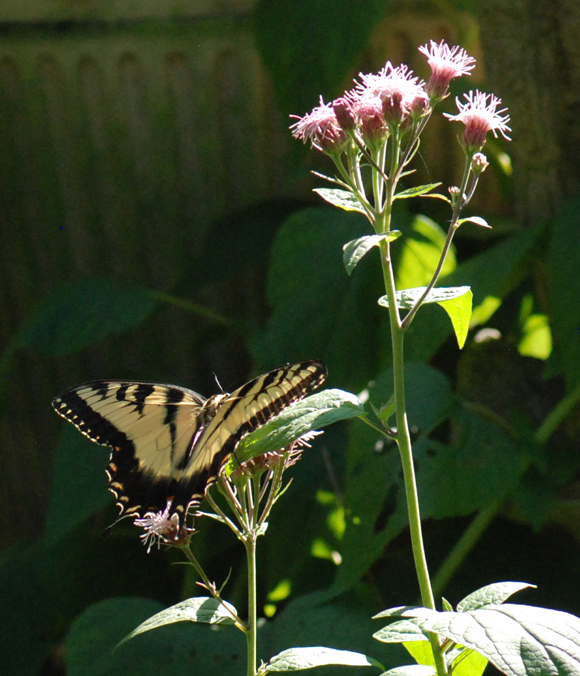
Swallowtails majestically visiting, but generally camera shy, like this Eastern Tiger Swallowtail (Papilio glaucus) nectaring at Flyr's Nemesis, ....

and even the occasional "rarity", like this Hummingbird Clearwing moth (Hemaris thysbe) that dropped in to feed at the Flyr's Nemesis while I was sitting quietly nearby, weeding.

With summer basically done, many plants are starting to look ragged, and that's okay.

There are the annuals and short-lived perennials, like this Indian Blanket (Gaillardia pulchella), that have bloomed valiantly all summer long and are suddenly just tired out, ready to call it quits.

There are the milkweeds, whose lower leaves dropped months ago and whose upper leaves are now caterpillar food, busily making new Monarchs.  (Look how tiny this little Monarch caterpillar is!  See how thick the leaf he's eating is in comparison to his size?!)

There are passionvines (Passiflora incarnata), whose holey-ness (or is it holiness?) speaks of many more Gulf Fritillaries to come.

The signs of fall may be more subtle here in the southland...but they are here all around me, nonetheless.

Monday, April 03, 2017

The Sap is Rising...and the Sapsuckers Are Visiting

Three days ago I noticed a pair of woodpeckers fly over to one of our pignut hickories (Carya glabra).  These deciduous trees are always late to leaf out, waiting until the azaleas are basically done blooming, most of the spring bulbs are finished, and the laurel oaks (Quercus laurifolia) have lost their old leaves and regained fresh, new ones.

We have 3 reasonably good sized pignut hickories in our backyard.  As a group, they are a great advertisement for the benefit of open-pollinated, seed grown trees:  none of the three does anything at exactly the same time as the other two.  These three trees leaf out at different times, develop fall color at different times, and drop their leaves at different times.  For a while I even began to wonder if they were actually three different species!

The big, terminal buds of the tree that the woodpeckers chose this weekend are swelling and just starting to break open.  The other two "sibling" hickories are still quiescent.  I'm not sure I would have noticed the changes in this tree if the woodpeckers hadn't shown up....

But show up they did - and they put on quite the show for several hours.  My first, fleeting impression was that this wasn't a pair of red-bellied woodpeckers, which are our common species here.  I've also seen downy woodpeckers and northern flickers in the yard, but this pair was obviously too big to be the former, too small to be the latter, and too "blandly colored" to be either of those species anyway.

So I got my binoculars and took a closer look.  A pair of yellow-bellied sapsuckers!

At first I thought the two were mating.  They would climb up the tree trunk almost in tandem for a while, then one would jump the other and they would tumble head over heels, dropping from 10 to 30 feet, hitting branches as they dropped.  Eventually they'd disentangle, right themselves on the trunk, and start climbing up again.  This went on over and over again, for several hours.  I presume they took breaks from their acrobatics, but I wasn't able to watch the entire time, so I don't know for sure.

Finally, in the early afternoon, the male flew away and I haven't seen him again.  The female remained on the tree, though, and was there again all day Sunday, busily tapping away on the trunk.

I don't have any photos of the pair, as I didn't want to interrupt their "dance" by getting too close.  I was able to get some photos of the female on Sunday as she worked on digging her sap wells and I worked on weeding the garden bed nearby.

I've since decided that this pair was probably fighting over food, not mating.  Yellow-bellied sapsuckers don't nest here - their breeding range is much farther north.  I don't think they'd actually be copulating this far south, long before they've completed their spring migration and found a breeding territory, let alone constructed a nest.  I think the sap is rising in this individual tree, based on the swelling buds, and these two birds were simply fighting over whose "territory" it was going to be while that was going on.   They just happened to be a male and a female.

Now it's going to be interesting to see if any sapsuckers stay around to feed on one of the other two hickories in the yard, as their sap starts to rise and their leaves unfurl later in the spring.

How can anyone get bored in a wildlife garden?!

Saturday, January 23, 2016

Native Plant Building Blocks

Having moved to a new (to us) house, new (to us) yard, in a different city, in a different state, I've shared that I feel like I'm starting completely from scratch again as I start to garden. This yard feels almost like a blank slate.

However, even a blank slate yard is never totally blank.  A suburban lot surrounding a house that's been lived in for almost 50 years is definitely not blank.  So, I've been watching the yard to see what's already living here, and I thought I'd share some of the native plant species I've found, the native "building blocks" that already exist in the yard for me to utilize.

Trees seem like the place to start.  The first thing I noticed coming up to our house last April was the big southern magnolia (Magnolia grandiflora) by the driveway, dominating the front yard. 

Unfortunately, it's not a good location for this species, since southern magnolias grow way too large for this space.  So, sometime in the past, big branches were pruned out of the tree to allow the electrical lines to go through the canopy.  There is also a southern magnolia in the back yard, although it is younger and smaller than the one in the front.

Next on the current yard list are the oaks, live oak (Quercus virginiana) and sand live oak (Q. geminata).  In the photo above, the big tree to the right of the house is our largest live oak.  Although there are many sand live oaks in the neighborhood, I think we only have one, a relatively small one, in our (back) yard.  On the other hand, we have 5 live oaks, 3 of which are quite unhealthy.  Unfortunately, none of our live oaks are terribly picturesque, having been limbed up to be "proper" trees, judging from their form.

Right now we only have one other tree species in our yard, pignut hickory (Carya glabra), but we have 3 mature specimens of this species in our back yard.  Pignut hickory is the only deciduous tree species we have. 

This photo, of one of the pignut hickories in the back yard, was taken in late June last summer.  I kept waiting for these trees to turn colors this fall, but it was a long wait.  The trees stayed green until December, when they turned a beautiful, bright yellow.  Leaf drop was rapid, once the leaves started to fall, and took place right around Christmas.  Not a traditional yard display for the holiday season!  If my memory serves, these trees are late to leaf out and won't get foliage back until April.

While there is a lot of Spanish moss (Tillandsia usneoides) in the neighborhood, we have very little in our yard - perhaps a result of how open the canopy is.  There IS some, though, and I'm hoping that we get more to grow over the years.

For quite a while, I've been eyeing this little prostrate vine and thinking that I recognized it - and I did. 

It's partridge berry (Mitchella repens), a gorgeous little evergreen groundcover with a wide natural range.  I had started to make the mistake of covering much of this plant up with mulch, but realized what I'd done when I went out to take the photo this morning. 

Here's the full scope of this plant, unearthed from below the mulch.  I'm hoping that this little guy will bloom (white) and maybe even set fruit (a bright red berry) later this year.

If you take a second look at the photo above, you'll notice a bare vine going up the tree trunk.  This vine is crossvine (Bignonia capreolata), a classic native landscaping vine in the south.  Here is a new stem, probably from the same root stock, climbing up a different side of the trunk. 

I'm excited to see this plant naturally in the yard, although this specimen doesn't look particularly luxuriant. Hopefully some better yard management will make it healthier.

Coming up in the middle of an old sand box, along the city storm drain easement, is a dwarf palmetto (Sabal minor). 

These are palm-y shrubs, with the trunk remaining underground.  I'm not very familiar with this species, although now that I know how to identify it, I'm noticing them all around.  This is one of many plant species I want (and need) to learn more about.

Last summer I noticed a rather handsome perennial plant growing at the base of one of the pignut hickories. 

I cordoned it off, so that it wouldn't get mowed, and watched it to see what it was.  Finally, in October, it bloomed a bright yellow. By the time it bloomed, though, the base of the plant had browned out badly.  I've figured out that this is golden aster, probably narrowleaf golden aster (Chrysopsis linearifolia), and the lower leaf brownout is actually listed in the plant descriptions. 

Most interesting is that, even with just a few buds open, there were actually little native bees using it in mid October.  So, now the challenge is how to disguise those lower leaves...and increase the plant population from my current n of 1, without jeopardizing that current, single specimen.

For now, the last plant I'm going to mention is Woolly Elephant's Foot (Elephantopus tomentosus), aka Devil's Grandmother, which I noticed and photographed last June.  I have no idea why it has earned either the name of "elephant's foot" or "devil's grandmother". This is not a showy plant at all, but it is both native and perennial.  I will almost assuredly keep it, but I may not try to expand its presence in the yard. 

I did like the fact that this little damselfly was using the bloom head to perch upon!