Friday, July 14, 2006

Goodbye to a pine tree

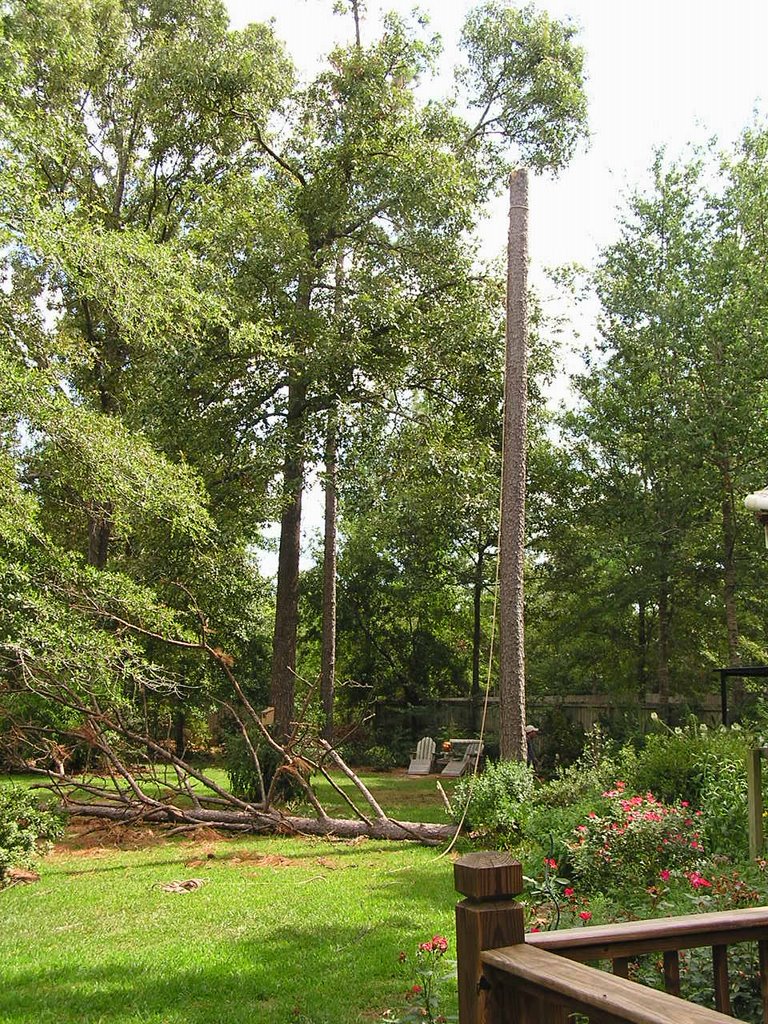
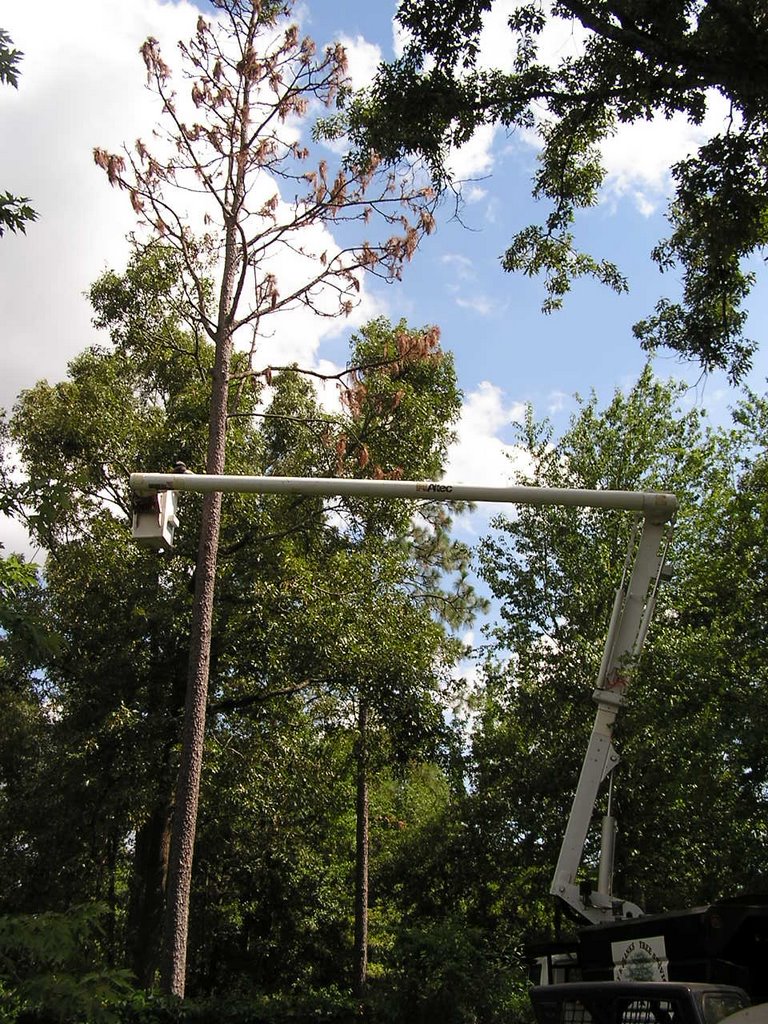
The tree guys finally got here yesterday and cut down the dead pine tree.

While I'm sad that it died and had to be cut down, I'm VERY glad that they got here and took it out before any tropical storms or hurricanes decided to take it out while rearranging our roofline.

The picture to the right here shows the first major cut being made. They had a rope tied to the top section to make sure that it fell in the direction they intended.


The second picture, to the left, shows the top down and the leftover "stub", which they rapidly felled to lie right beside the top.

After cutting the trunk up into 8-10 foot sections, they systematically loaded everything up into the bucket of a Bobcat and carried it out of the yard to a waiting dumptruck. Even the pine straw was eventually scooped up into the bucket.

In less than 1 1/2 hours, they were done. The tree was gone, the stump was ground up, and a new normal was being established in the yard.

The thing that amazes me the most is how open and vulnerable that area seems now. Since the tree has been dead for almost 2 months, and since we saw nothing but the bare trunk at our eye level, I didn't expect to feel as much of an impact in the yard as I do. It will be good for the butterfly garden to get a little more sun, but we've lost any sense of destination and/or enclosure for the "Outback" seating area.

A little side note: the tree was younger than I expected. Counting the rings, I estimated that the tree was between 42 and 47 years old, depending on how long it had stayed in the "grass" stage. Overall, about my age or a little younger. Somehow that gives me pause.

Life goes on. Typical of any gardener, I suppose, I'm already planning what I'm going to put in the empty space. Suggestions anyone?

Tuesday, July 11, 2006

Meditating on Weeds...and IPM and Lawn Care

As I did my walkabout this afternoon, I kept thinking of the concept of weeds.

My favorite definition of a weed is "a plant out of place." Therefore, an oak seedling can be a weed in a lawn; grass is often weed in a garden bed. The plant species is not really the problem, it's the placement of the plant that is at issue.

A weed is just a plant out of place. That's all. A weed is not the precursor to the downfall of civilization as we know it. It is not Public Enemy #1. If weeds make you feel slightly (or very) panicky, you've been watching (and believing) too many herbicide commercials on TV. Remember (and repeat after me): "The goal of herbicide commercials is to sell herbicide...and fear is a good sales technique. Weeds are not evil creatures of the devil waiting to ruin my home and yard. Weeds are simply plants out of place."

That being said, weeds can take nutrients away from the plants we desire to grow. As such, we often want to remove them from our lawns and gardens. In a garden setting, weeding by hand, mulching the beds, and maintaining appropriate mowing/watering schedules for the lawn are usually all that is necessary for reasonable weed control. Generally "command and control" is a better weeding motto than "total eradication." You're not going to achieve the latter anyway, and you're going to waste a lot of money and poison a lot of earth trying to do so.

All this leads me to a difficult confession, though. Our yard can no longer really be considered organic. As we get ready to move, we are more truthfully operating under "Integrated Pest Management (IPM)" strategies. Specifically, Prairiewolf has been spot-spraying broadleaf weeds in the lawn with an herbicide as he mows.

I am not happy about this.

The lawn is looking the best it has ever looked. You could make the case that the herbicide weed control is the reason for the lawn's health, but I think it's more because of several other concurrent factors:
1) We finally realized the importance of regular watering to the health of the lawn grasses here in the Deep South, and therefore we have been watering religiously whenever the grass begins to get that gray-green color that denotes water stress. Centipede and St. Augustine, our two turf grasses here, don't really go healthily dormant when drought occurs like fescue and many other turfgrasses do.
2) Prairiewolf has been mowing extremely regularly. To my knowledge, he has only missed one weekend all summer. This is much better for the grass than skipping weekends and letting it get too tall. Keeping a consistent height encourages runner formation and keeps the grass from getting too stressed by having too much leaf surface cut off at once.
3) We have been gradually changing out the backyard grass from centipede, which can't handle shade, to St. Augustine, which can. The St. Augustine is doing much better under all our trees.
4) Whenever we get any brown spots or unhealthy looking areas in the grass, Prairiewolf brews up some compost tea and treats the area(s). This has proven to be a wonderful remedy, keeping the lawn much healthier overall.
5) Besides mowing the grass regularly, Prairiewolf has also been cutting the grass quite high. This keeps the soil cooler, prevents a lot of weed seed germination by keeping the soil surface shaded, decreases water evaporation from the soil, and generally reduces stress on the grass.
6) Last but not at all least, we haven't caused or been the victim of any real goofs lately - goofs like killing the "dormant" centipede by applying Round-up to the embedded winter weeds in January or having a contractor kill a large swath of lawn in the middle of the front yard by laying down clear plastic to "protect" the grass as he painted the front door. Come to think of it, it's been a couple years since those things happened. (Knock on wood!)

So there are a lot of reasons why the lawn is looking good this year. It's a lot more than just the broadleaf herbicide. In fact, I contend that it doesn't have anything to do with the herbicide...but I'm sure that Prairiewolf will contest that statement!

Any way you look at it, weeds are a powerful issue in gardening circles.

Can animals be "weeds"? Why not?

How about people? ...It's an interesting concept to meditate about during my next walkabout in the back yard.

Back in the Saddle Again!

The painters finished the living room this afternoon (YEAH!!!!) and I have actually been able to do a walkabout in the garden, with blueberry ale and grocery bag in hand, repairing armadillo damage, clipping back overexuberant growth, and pulling weeds.

As a testament to how carefully I put the garden "to bed" last month, it took me less than one hour and only one plastic sack (albeit a full one) to complete my rounds in the backyard. Of course, with the armadillo(s) rooting around nightly, the weeds don't have much of a chance to grow in several of the beds. Neither do the garden plants for that matter.

Be that as it may, it felt great to be back in the garden in a relaxed, gardening mode. I hadn't realised how much I missed it.

Wishing for Rain

I'm back from San Antonio, where I actually got to experience that wet stuff falling from the sky. I hear it's called rain. Funny, we haven't had much experience with that here in Mobile lately. For a city that I've seen described as the wettest metropolitan area in the continental U.S., that's rather unusual.

I saw a report on the Weather Channel this morning - Mobile is behind over 20" of rain for the year. Given that our specific location has missed at least 5" of rain that the airport received during the last few months, that makes our yard/garden behind by about 25". And that's just for this year. We were dry for the last 4 months of 2005 too.

My water bill was outrageous last month (about 6X normal, to be somewhat more precise). In the area of the yard that I haven't watered, even the pokeweed (!) is wilting.

There's a chance that we'll get rain on Thursday, Friday, and Saturday this week. I'm keeping my fingers crossed. (For the uninitiated, that's my tried & true, highly scientific method of encouraging events to happen....) Meanwhile, I'm dragging hoses around the yard and figuratively watching the water meter spin around and around.

And I'm thinking of all the places that are flooding this year...which reminds me of "An Inconvenient Truth". If you haven't seen it yet, I have to reiterate: Go see it. You'll be glad you did.

Thursday, July 06, 2006

A Different Way to Live Life - An Older Way?

I just finished reading Hannah Coulter, by Wendell Berry. It's a first person narrative (fictional) of an old woman telling the story of her life from before WWII to sometime around 2002, and it left me with a sense that here was a key to a deep kind of happiness and sense of belonging that few of us seem to find these days.

What struck me most about this book was its depiction of a different way to live, a way that is perhaps older and more natural for humans than the frantic activity and amassing of stuff that passes for life these days.

Through his fictional Hannah, Berry talks of the "membership" of her life - of belonging to a place and to a community of people. He talks of the bond that develops between the land and a person or a family living on that land for most of their life (and getting their livelihood from that land) - how each mirrors the other.

p. 106: "You can see that it is hard to mark the difference betwen our life and our place, our place and ourselves.
As the years passed and our life changed, the place changed. It emerged, you might say, from what it had been into what we needed and wanted it to be, never perfect of course, but always a little better. It came under the influence of what we foresaw in it, and of our ways of using it and going about in it."

That quote spoke to me. I've sometimes wondered what the places we've lived in - or more precisely, what the land that we've lived on - would be like if someone else had lived there instead of us.

But back to the book.... In talking about the "world of membership," Berry contrasts it to the "world of employment" or the "world of organization." In the latter, he says you are disconnected and free, but you are also disposable and unmemorable, interchangeable with many others. "But the membership...keeps the memories even of horses and mules and milk cows and dogs." (p. 134)

There are nuggets of advice about living life scattered throughout the book too. How Hannah was almost most in love and aware of her husband when she was angry with him...and of how often she observed men picking fights with their wives simply because they were feeling neglected. How "the chance you had is the life you've got" and you shouldn't complain about the chance you got because it cheapens the good things and good people that you've shared your life with. How always searching for some mythical "better place" often leads to an unravelling of family and continuity and thus to a worse, more disconnected place.

This was a book to read slowly and to savor the language and the thoughts. It's not a gripping story; it's more like a window into someone's soul as she thinks back over her life. At times it even felt like a window into the soul of an old-fashioned community that is slowly dying as the people who should be keeping it alive move away to find a mythical "better place." It was listening to an elder think back over her life and evaluate its richness and its rough spots, and finally the love that bound it together and made it worth living.

Idealizing a mythical place and way of being is seductive and dangerous, and I can see where this fictional account could itself fall very easily into that category. Yet it can also be instructive to try to imagine a different way of being in the world that speaks to some of our deepest longings and needs as human beings, longings and needs that aren't being met by our current societal patterns. For me, this book does just that.

"Be careful not to throw the baby out with the bathwater." It's an old maxim, but it speaks a deep truth. Maybe, just maybe, this book is saying that we've done exactly that. Now we would be wise to figure out how to rescue the baby and start taking careful care of it again.

Another Place

I am in San Antonio this week, helping our daughter move into and establish her new home.

It's a new world here. The vegetation is so different from either Kansas or Mobile. I barely recognize any of the trees or shrubs. In a way it's invigorating and exciting, and in a way it's disconcerting.

I'm beginning to learn a new rhythm of place. Wasps seem to be a lot more abundant here, starting nest after nest under the eaves and on the porches. There are big wasps and little ones, but most seem to be paper wasps of some variety or another. A large nest of small wasps under the eaves of the house next door entertains me with its comings and goings as I eat or read at the kitchen table.

A small scorpion scampered across the kitchen floor last night, tail held menacingly high over its back as I came up to look, admire, but ultimately to squash.

Earwigs, ants, spiders.... They have all been in the new house over the last few days. I'm guessing that they are the dispossessed, and I feel bad that their habitat is gone. For better or for worse, as humans we move into a new habitat and force out its old inhabitants. We are not very good neighbors.

It will be a challenge to learn the workings of this new place as I help Jess settle in to this new place, especially since so much of my learning will have to be done from so far away. I relish the challenge, though, as it will make me feel ultimately more a part of life in general, and thus ultimately much richer.

An Inconvenient Truth

An Inconvenient Truth is incredible. Go see it. Please.

Prairiewolf and I went to see it last Friday, after we accidentally discovered that it was unexpectedly showing in Mobile. I didn't have very high expectations, given that it was supposedly based on a slide show, it was about a topic I'm fairly familiar with, and it was showcasing Al Gore. (Although I think Al Gore got the shaft in the 2000 election, being unfairly tarred with Clinton's faults and not seriously examined as a man in his own right, I also found him stiff and less than riveting, despite being obviously intelligent and thoughtful.) Nonetheless, the reviews of An Inconvenient Truth had been good and we wanted to support the idea of a serious, thought-provoking movie amidst the deafening blather that normally passes for entertainment in this country.

The movie is a thoughtful documentary that will literally change the way you see the world.

If you tend to agree that our world needs thoughtful care, go see it because you will learn new things, see fascinating photos, learn incredible statistics, and generally come away with a new energy about actively working to better our planet.

If you tend to disagree that we need to take better care of our world, then please see it anyway to let me know where you find flaws in the reasoning and factual information presented. I would dearly love to hear both sides of this issue.

Wednesday, June 28, 2006

The Armadillo is Dead! Long Live the Armadillo!

When Prairiewolf came in at dawn on Sunday morning and quietly announced that he had dispatched the armadillo, all I could think of was, "The armadillo is dead! Long live the armadillo!" In the typical fog that attends my earliest morning thinking, I couldn't remember what the original quote actually was, or where it came from. Eventually it came to me that I had reworded the salute that is traditionally given when royalty dies.

Not that "our" armadillo was royal (unless you count acting like a destructive force as royal behavior), but the phrase contiued to echo in my head all that day. Finally that evening, I sat down and typed in a blog entry, both celebrating and mourning the passing of the armadillo.

Then fate took a hand. As I finished the blog entry, a thunderstorm was brewing. When I tried to post the entry, we lost our internet connection and my blog entry disappeared into that cyber-nothingness from which there is no return. In fact, fate was really feeling spunky that evening, because it turned out that something in our DSL server had been fried seriously enough that we didn't get internet service again for over 24 hours.

In the meantime, the next morning I decided to do my normal morning walkabout, looking forward to the first clean-hands venture in weeks. (After the armadillo had been rooting around, every morning walkabout included filling in holes, smoothing mulch back into place and sometimes replanting entire uprooted plants.) As I started out, strolling by the butterfly garden, my heart sank. There was a fresh hole in the grass. A little further on, there were a couple more holes, and over in the fern bed it looked like a little boy had been playing with his frontloader between all the plants and along the front edge. Several of the holes were 6" deep and 10-12" wide, at the base of some of my most delicate plants. All the holes were fresh. An armadillo had definitely been at work. Again.

Prairiewolf assures me that it can't be the armadillo that he killed Sunday morning, so we are left with the inescapable conclusion that we had more than one "little armored one" dining in our garden. We've spent the last two nights getting up several times throughout the night, trying to catch the second one in the act of foraging, but so far we've been unsuccessful. We'll keep on trying as long as our less-than-young bodies can take the lack of sleep.

"The armadillo is dead! Long live the armadillo!" I guess the phrase ringing in my head was prophetic after all.

Friday, June 23, 2006

Thoughts on "The Disenchanted Kingdom"

I've read another excellent interview article in one of my old Sun magazines. This one, by Derrick Jensen, is with George Ritzer and they are discussing the "McDonaldization" of American (and increasingly human) culture.

The article, "The Disenchanted Kingdom: George Ritzer on the Disappearance of Authentic American Culture," appeared in the June 2002 edition of The Sun. Here are a few excerpts from the article that caught my eye....

p. 6: Jensen: What is "McDonaldization"?
Ritzer: It's the process by which the principles of the fast-food industry - efficiency, predictability, calculability, and control through technology - are being applied to more and more sectors of society in more and more parts of the world.

p. 7 ...people who try to be creative are likely to get fired because, from the point of view of the system, they are more likely to mess things up. One of the irrationalities of rational systems is that the system - a nonliving thing - takes priority over living beings such as workers and consumers.

p. 8 The preparing and eating of meals is one of the most basic of human expressions. In most cultures, meals are something to be savored, to be enjoyed communally, to be lingered over....
Fast-food restaurants - and consumer culture at large - work to eliminate genuine human interaction, because interactions are unpredictable and waste time.

p. 8 German sociologist Max Weber called this the "disenchantment of the world." In a progressively rationalized culture, the magic, the mystery, the religious qualities of the world are always being challenged....
...Anything that is magical or mysterious is apt to also be meandering and inefficient. Furthermore, enchanted systems are often complex and highly convoluted, having no obvious means to an end. And how do you quantify the enchanted? Since it cannot be readily calculated, it is ignored and quite often eliminated.

p. 9 Jensen: So, having disenchanted the world, these McDonaldized systems offer us a sort of simulated enchantment in its place.
Ritzer: Yes, Las Vegas is a perfect example of this. Its casinos and hotels are not "real" enchanted settings. There's a phony New Orleans, a phony Paris, a phony Venice. They get people in the doors by providing huge simulated extravaganzas in an ordered, clean, controlled environment.

p. 10 ...there seems to be a relationship between excluding the natural world and controlling people....
....The great advantage of artificial settings over natural ones is their controllability. If you want to use people's surroundings to control them, your settings have to be unnatural. The sad thing is that, in our society, increasing numbers of people seem more attracted to these simulated settings than to natural settings.

p. 10 There are fewer and fewer places we can go to get away from this manipulation. Where can we go anymore to learn how to be real human beings?
In a way, we are turning into a new species of human. The incessant bombardment by these various forms of manipulation distorts us into McDonaldized pseudopeople who no longer even know what we want, but have to be told. And even if we manage to retain some idea of what we really want, McDonaldized society increasingly deprives us of the opportunity to get it.

p. 10 Another irrationality of rational systems is homogenization. McDonaldization is about the elimination of differences. There is virtually no difference between regions of the United States anymore, because they've all been McDonaldized.

p. 11 ...the more time we spend engaging in meaningless interactions in simulated settings, the less we are able to engage in authentic, meaningful relationships. "You are what you eat" is true not only for the food we take into our bodies, but also for our other modes of consumption: the images and instructions we internalize.

p. 11 The most powerful system is that which leads people to police themselves, without any perception on their own part that they're being controlled.

p. 13 How do people who've been taught to be subordinate - at home, at school, in the workplace - become active, creative agents in a changing society?

p. 13 In many ways, our method of rationalization is much more resilient than a centralized totalitarian system, because we have a multitude of separate systems of rationalization and McDonaldization. Consequently, it's much harder - and getting harder all the time - to tell who the enemy is. And even when we do identify an enemy, it doesn't necessarily do us much good.

p. 13 Ritzer: People often ask me why, if I'm so pessimistic about the possibility of a solution, do I bother writing about the problem. The answer is: to increase awareness. When we're conscious of being controlled, it becomes much harder for those in power to maintain that control....
...It's sometimes remarkably easy to throw a monkey wrench into the system. That's one reason why the system tries to eliminate creativity: because creative action can cause the system to fall apart.
Thursday, June 22, 2006

Drifting Thoughts

Yesterday was summer solstice. As seems to be our habit lately, we didn't celebrate it particularly, but we did remember it. We're trying to start marking these seasonal markers, but finding it rather hard to know how to do it appropriately. Copying supposed ceremonies from religions that do (or did) mark these days seems too contrived and somehow disrespectful for people who aren't actually members of those religions. Starting your own meaningful traditional ceremony is turning out to be amazingly hard.

The ceremony we really need is a rain dance. We are dry, dry, dry. According to last Saturday's paper, from last Sept. 1 to the prior Thursday (June 15) was the driest such period on record for the Mobile area since record-keeping was started in 1930. Even with almost nonstop watering going, I'm starting to see signs of major water stress in the yard - I'm probably going to lose the Hummingbird clethra in the front yard, and the autumn ferns under the live oak are looking crisp. Areas of grass, especially in the sunny areas of the front near the pavement, are drying out almost as fast as I can water them. I'm dreading the water bill.

The tree people haven't come yet to cut down the dead pine tree. I'm just trusting that they will come before the first hurricane. Meanwhile, the second pine tree has several branches that have died at the top, leaving me trying to decide whether to go ahead and cut it down or keep hoping that it can seal itself off and recover. The cynical, paranoid part of me says that the tree folks are just waiting as long as possible to see if that second tree dies so that they can make twice as much money.

I'm feeling like a prisoner in my own house, sitting here waiting while the painters work. Since I don't want to bother them, I'm basically confined to the kitchen and living room, but I have very little to do in here. (They've been working on the hall, upstairs and downstairs, for a week now and they are still not done.) So I'm reading my back issues of The Sun, reading and writing blogs, and watching a little TV. And talking way too much to the animals. I worked through the backlog of charity appeals on Friday, baked cookies on Monday and had a plant sale meeting yesterday morning, but otherwise I'm just sitting here trying to keep from going crazy. It's getting harder and harder each day.

Good news from the garden:

Patty's pink crinum is blooming for the first time. It's a very pretty, fresh shade of medium-light pink.

My pink Amarcrinum (a cross between an amaryllis and a crinum) has a big pink bud on it too. I'm looking forward to seeing that bloom as well. This is the second year it has bloomed.

The summer phlox is blooming. Although I have at least 3 different varieties, they are all blooming the exact same color of fuschia, leading me to suspect that they've reverted. They're still pretty, and hopefully they've managed to retain the mildew resistance that was one of the characteristics I selected them for.

Last but not least, the Grape Sensation gaillardia has another bloom at long last, despite almost being uprooted by the armadillo. Actually, the plant's looking pretty healthy overall. It's supposed to be a hort variety of an endangered species, so I'm particularly excited that it seems to be thriving in the garden. It wouldn't be the first time that gardeners have rescued a plant from the brink of extinction, but it would be particularly exciting to be part of the rescue!

Speaking of a plant almost uprooted by the armadillo, there are no major developments on that front. The damage has been lighter lately (and almost nonexistent last night), but I've learned my lesson about premature celebrations.

Send thoughts of soaking, gentle rains our way!

Tuesday, June 20, 2006

Thoughts from "Down to Business: Paul Hawken on Reshaping the Economy"

As I'm sorting through my old Sun magazines, prior to recycling them, I'm finding some wonderful articles. I've decided to start excerpting quotes from the ones that speak the most strongly to me.

This article was in April 2002, an interview by Renee Lertzman with Paul Hawken entitled, "Down to Business: Paul Hawken on Reshaping the Economy." Most of the quotes are excerpted from Hawken's replies to Lertzman's questions.

p. 7: Human society is a subsystem of Mother Earth. As the earth changes, every aspect of society is transformed. It is happening before our eyes. Most of the changes cause suffering. This is the problem, but also the starting point for intervention: how do we relieve suffering?

p. 7: ...business is not the purpose of society, and it's certainly not our purpose on earth. Businesses can serve humanity, alleviate suffering, and nurture life, but those that do are far too rare. [Emphasis (bold) added by me.]

p. 10 [Hawken speaking] I would never suggest that any solution is the "only" means of solving a problem. If we are dwelling within a system that is degrading life on earth, then every node of the system requires attention. This is heartening because it means that farmers, teachers, mechanics, parents, architects, and people in every other vocation have a role to play. We are not talking about change from on high. We are not talking about charismatic white males leading a sustainability revolution. This is change from the margins, from the understory.
...if we think of SUV owners as careless, nonthinking despoilers of the commons, we are further in the hole, because then we are marginalizing - if not demonizing - our fellow human beings. Not a strong basis for change. This world is riddled with ignorance. You can blame people who knock things over in the dark, or you can begin to light candles. You're only at fault if you know about the problem and choose to do nothing.

p. 12 Bear in mind that the American colonies rose up not against the tyranny of a crazed King George, but against the rule of his chartered corporations.
In essence, America was created to end corporate abuse. That we have become what we feared is ironic, and would be merely of historical interest were it not for the fact that corporate activity today threatens life itself.

p. 12 Marx was wrong. Religion is not the opiate of the masses. The drug of choice is the materialism flowing from corporations.

p. 13 Lertzman [the interviewer]: How do you respond to the other question: Is there enough time for us to correct our destructive trends?
Hawken: I usually respond that time is irrelevant.... We cannot know the future, not even a minute from now. What is critical is to be engaged in something that is worthy, to live a life that you will feel good about when you die, even if you die tomorrow. When you are engaged in this way, the issues of life and death and time become less important than the care and grace with which you serve. [Emphasis added by me.]

Monday, June 19, 2006

Reading in the Wee Hours

After giving up the hope of sleep due to the excitement of the armadillo chase, I eventually moved into the recliner last night and picked up another old Sun to read before consigning it to the recycling pile.

It was the August 2002 edition. The feature interview was with Duane Elgin, "On Simplicity and Humanity's Future."

I flirted with the voluntary simplicity movement 15-20 years ago, not long after Elgin wrote his first book, Voluntary Simplicity: Towards a Way of Life That Is Outwardly Simple, Inwardly Rich. I've always appreciated the general tenets, but found the "real life" practice much harder than it sounds. It was interesting to read about voluntary simplicity again, and to see how much farther Elgin has moved in his thought process.

A few points really struck me in revisiting this concept. First of all, voluntary simplicity is VOLUNTARY. Since economic hardship isn't voluntary, this isn't a "noble" state to which we can justify confining people by paying them low wages. Secondly, the point of voluntary simplicity isn't to deny ourselves. The point is to prune out nonessential areas of our lives so that we can more fully appreciate and enjoy the areas of our lives that bring us joy and meaning. Because what brings us joy and meaning is individual to each of us, voluntary simplicity will look different to each person.

(This reminds me of a story I heard years ago. A college professor asked her students how many shirts they needed to make them happy. Were 7 shirts - one for each day of the week - enough? Double that? Ten times that many? How many shirts and what was their rationale? She had them write down their answers and their rationales, then she had them go home and actually count how many shirts and shirt-like garments they owned. Most owned many, many times the number of shirts they had logically decided that they needed to be happy.

A hundred years ago, few people owned more than a couple changes of clothing. Yet we often romanticize that time as happier than ours.)

I can hear the comments already - "But I like having hundreds of shirts. It makes me happy to have this much choice!" And I'm not going to argue. I just know that FOR ME, I've been discovering that the more stuff I have, the more of my time and energy I waste taking care of it. I'm tired of spending my life that way. There are 2 especially hard parts to this, though: 1) refraining from getting more new stuff that I just "know" will make me happy, and 2) choosing what, out of everything that we already have, we can easily and happily do without.

To quote Elgin in this article, "The simple life is about freeing up time for what matters most to us."

I could go on for a long time (face it, books have been written about this topic!), but I'll keep it simple for now. I think, maybe, that it's time for me to seriously revisit these ideas in my life.

Midnight in the Garden - It's Good and It's "Evil"

Okay, so it wasn't midnight actually. It was 2:30 a.m., then 3:50 a.m., and then 4:40 a.m. We came, we saw, we tried to conquer.

The good news is that it's only a single armadillo. The bad news is that he has his main burrow under the shed...and he is extremely persistent.

Waking up at 2:24 a.m. due to normal insomnia (I just quit taking my nightly allergy pills, assuming - corrrectly - that my body would help me in this endeavor without having to set an alarm), I grabbed a flashlight, stuck on my gardening Birks and ventured by myself into the jungle of the garden at night. I couldn't hear the snuffling that the armadillos are reputed to make as they forage, so I simply walked slowly towards the back, listening carefully as I went. About halfway to the back I thought I heard some movement and turned on the flashlight. With very little trouble, my culprit, a full grown armadillo, was caught in the spotlight, which he made no real effort to avoid.

I followed him cautiously for a while, then decided to call out the troops. Back in the house, Becker was alert and ready for action; Prairiewolf took a little more time, but he was game too. In short order, all three of us were back to the chase. Again, it was easy to spotlight Mr. Armadillo; this time we encouraged Becker to go investigate.

As soon as he realized what we wanted him to do, Becker enthusiastically bounded over to take a look...and Mr. Armadillo went running for safety, with Becker in immediate, hot pursuit. Which is how we discovered the burrow under the shed.

I couldn't get back to sleep, so Becker and I went back out 2 more times last night. Both times Mr. Armadillo was busy foraging in my garden beds. Both times Becker enthusiastically gave chase. Since the chase led inevitably through the middle of my ferns and butterfly gingers the second time, and through a thickly planted perennial bed the third time, the cure is potentially as bad or worse than the "disease," but I'm hoping that Mr. Armadillo will get tired of being chased and move on to quieter feeding grounds.

At least we learned that there's only one, and where he has his main burrow. One way or the other, we are going to make this garden a less hospitable environment for him...I don't use a mechanical roto-tiller; I'm darned if I want an out-of-control natural one working in my garden every night either!

By the way, the first cardinal started singing at 5:08 a.m. this morning. It was pitch dark and beautiful.

Sunday, June 18, 2006

Know Your Enemy

Some interesting facts about armadillos that I've learned:

1) Armadillos are mammals, in the same family as anteaters and sloths. They originated in South America.
2) There are actually 20 different species of armadillos, but only one species (the nine-banded armadillo) currently lives in the U.S.
3) Most species of armadillos are threatened or endangered. Currently only the nine-banded armadillo is actually increasing its numbers and range.
4) Nine-banded armadillos always give birth to four identical young (called pups or kits) - which develop from the same egg and share the same placenta. The female armadillos have only 4 mammary glands, one for each pup.
5) Nine-banded armadillos eat primarily small insects, which they slurp up with their long, sticky, saliva-covered tongue. Ants and beetles (including grubs) are their favorites. If pressed due to lack of insects, they will also eat plant material, carrion, and even occasional small mammals, eggs, and/or nestling birds.
6) Prior to about 1850, armadillos were not found north of the Rio Grande. Their range has currently expanded north to Nebraska & Missouri and east to Florida & South Carolina. This range expansion is occurring almost ten times faster than would normally be expected for a mammal species.
7) If startled, an armadillo will often jump 3-4 feet straight up into the air. While this is great for startling its predators, it usually proves to be a fatal response to an oncoming car.
8) The word "armadillo" means "little armored one" in Spanish.
9) Nine-banded armadillos cannot roll up into a tight ball. They usually run to a nearby burrow, dig into the ground or hunker down tight against the ground when faced with a predator. (Except, of course, when they jump straight up into the air - see #7 above.)
10) Armadillos are considered an important part of ecosystems because of their insect-eating (and therefore insect-controlling) habits. If you can stand their hole-digging habits in your yard, there is benefit to be gained by their appetite since they are excellent grub control.

Unfortunately, I'm having real issues with their hole-digging habits....

Sources of information:
1) http://www.msu.edu/~nixonjos/armadillo/
2) http://www.mdc.mo.gov/conmag/1997/03/30.htm

Days (Nights, Really) of Depressing Destruction

I was incredibly naive. After a single day of no armadillo sign, I was hoping that our armadillo had moved on. Prairiewolf proudly (and unknowingly) blew that theory to Hades when he came in Friday evening announcing that he had made a discovery I would be quite excited about: he had just found the location of the armadillo burrow. Sure enough, there it was - well hidden and tucked in beside the Monstera philodendron, at the corner of the deck and house, going underneath the foundation.

So we dug out our livetrap and set it up, next to the burrow, with a concrete paver blocking off any other egress. To make a long story short, that didn't work.

In fact, it seemed to backfire with a vengeance. The next morning almost every bed in the yard had been mutilated, to one degree or another. Damage had never been this severe or widespread before. Several of my more special plants, including my Drimiopsis kirkii (South African hosta) and my Labrador violet, were almost totally uprooted. Everywhere roots were exposed and large holes had been left, thoroughly mixing the mulch with the dirt. I had visions of losing almost every fern and perennial in the yard.

I spent most of the day wondering if I should just quit trying to garden here. After all, we will be moving within the year. There will be no time to reestablish a garden; nor is there any point in spending the money to buy replacement plants. With our current heat and drought, trying to keep the uprooted plants alive, let alone flourishing, is going to be an incredible challenge.

To make me feel even more depressed, another pine tree was showing signs of dieback and my black swallowtail caterpillars appeared to have disappeared. (I can only watch the pine tree and see if the entire crown dies; the caterpillars are probably making new muscle or pinfeathers in two of the many birds, fledgling and adult, currently foraging in the yard.)

By yesterday evening, though, I had recovered enough optimism to fight back. One of the armadillo sites on the Internet mentioned that they don't like pine needles, and that seems to be borne out by the fact that our front yard beds, mulched exclusively with pine straw, haven't been bothered. So I remulched my most vulnerable bed with some chopped up pine straw mulch that I had piled up by the compost pile. We took the trap down, too, to make sure that we didn't force the armadillo into digging a new, undiscovered burrow.

The armadillo was quite active again last night, but at least it wasn't quite as destructive as far as uprooting plants. The pine straw mulch idea didn't work. This morning that bed was just as thoroughly dug up as any of the others. With the new level of damage each night, I'm beginning to suspect that we actually have a litter of young armadillos (they occur 4 at a time) living under the house, with or without their mother.

Despite all that, I'm retaining some optimism. Today we built a partial chute coming out from the burrow; tomorrow we'll complete it and try the livetrap again. If, after a few days, that doesn't work, we'll try harassing them out of the yard through mothballs or ammonia-/vinegar-soaked rags in the burrow, or our large, increasingly territorial, young German shepherd left out for a night or two. I'm keeping my fingers crossed that something will work. At this point, all I can do is keep trying.

Wednesday, June 14, 2006

The Sky is the Same Color....

As I started working through a pile of magazines I've been saving, trying to work towards recycling them in my efforts to clear things out before moving, I couldn't help but dip in and read a bit. This quote jumped out at me:

Wherever you go, the sky is the same color.

Supposedly a Persian saying, it appeared in a list of quotes, "Sunbeams," published in The Sun, June 2004.

I like this saying; it's been resonating with me ever since I read it. It soothes me as I think about starting over again. It encourages me to remember that "we're all in this together." And somehow it makes me remember that the world is not really all that big a place.

Caterpillar Days of Summer

"Wonder of wonders! Miracle of miracles!" This morning was back to the more normal relaxing - and productive - morning walkabouts. In other words, no armadillo signs. Do I dare to hope that he/she has moved on to greener pastures?

Botanically, the garden is slowing down for the summer. The biggest and showiest bloom seasons have basically finished now. The azaleas and spring bulbs are long gone. The wisteria, iris and daylilies are done. Even the hydrangeas are almost over now.

The butterfly garden is still full of blooms, though, and the Knockout roses are continuing to flash their deep fluorescent pink flowers in big, bold clusters. (I've been careful to keep the Knockouts dead-headed, and I think it's paying off.) But most of the rest of the plant life is settling in for the long, hot, quiescent period, when it grows steadily but with no frills.

The animal life is increasing steadily, too. I've seen fledgling blue jays, mourning doves and cardinals in the yard lately, and I'm guessing that a couple of the "female" hummingbirds I've started noticing are actually this year's young.

Speaking of hummingbirds, I noticed an interesting quirk this morning. When a hummingbird stuck its bill into the salvia bloom to start feeding, it would almost always move the bloom up a little, changing the bloom's angle to a little above the horizontal. Does that make the nectar in the salvia blossom a little more accessible? Or is it simply a more convenient angle for feeding, based on the hummingbird's flight pattern and anatomy?

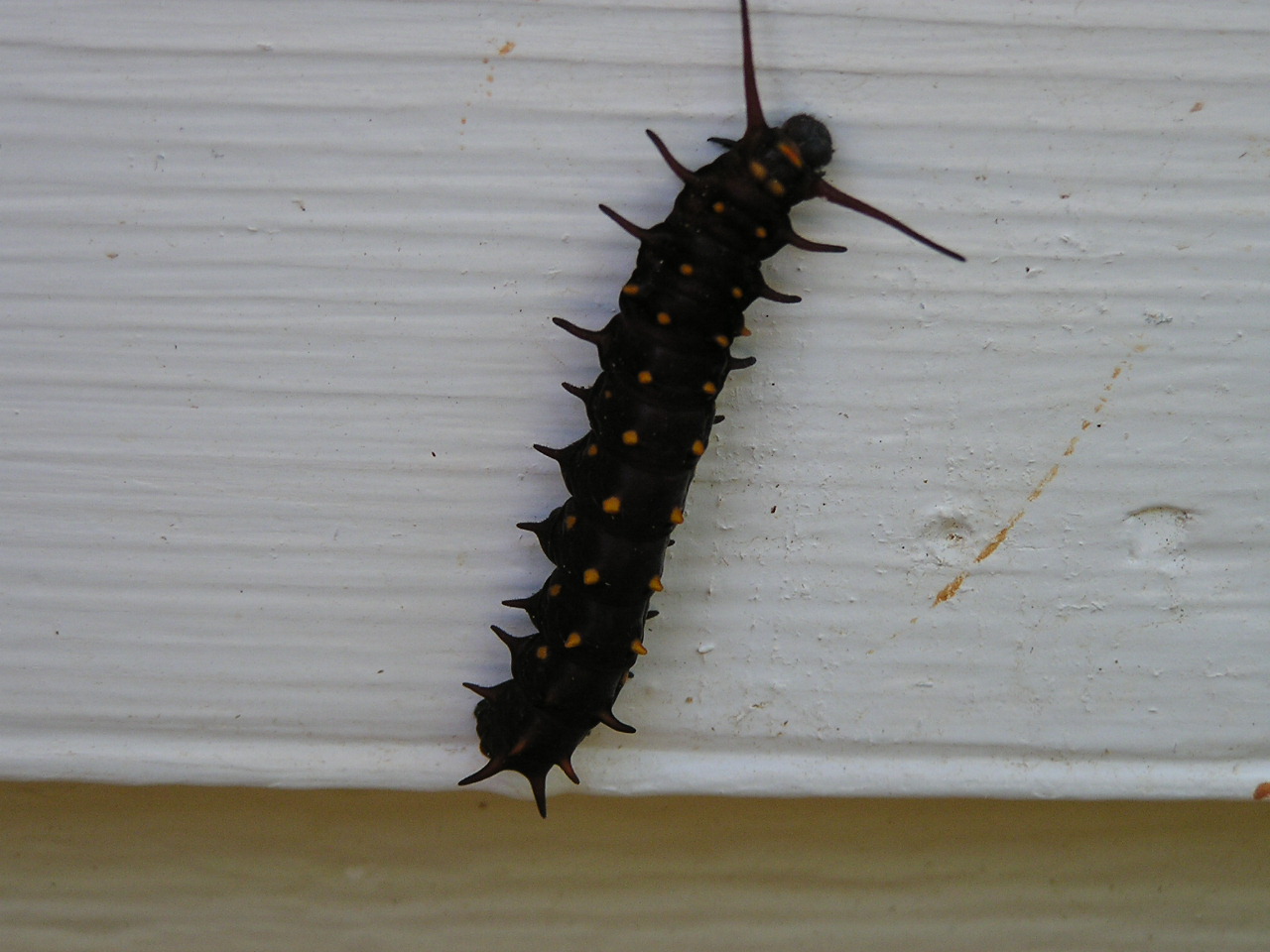
It's the start of serious caterpillar season, too. Last week I found a pipevine swallowtail caterpillar wandering around the deck, presumably looking for a good place to pupate.


Then this morning I noticed two black swallowtail caterpillars on the volunteer parsley plant in the butterfly garden. The caterpillars are only 1/3 of full size, so I'll get to watch them for quite a while still.


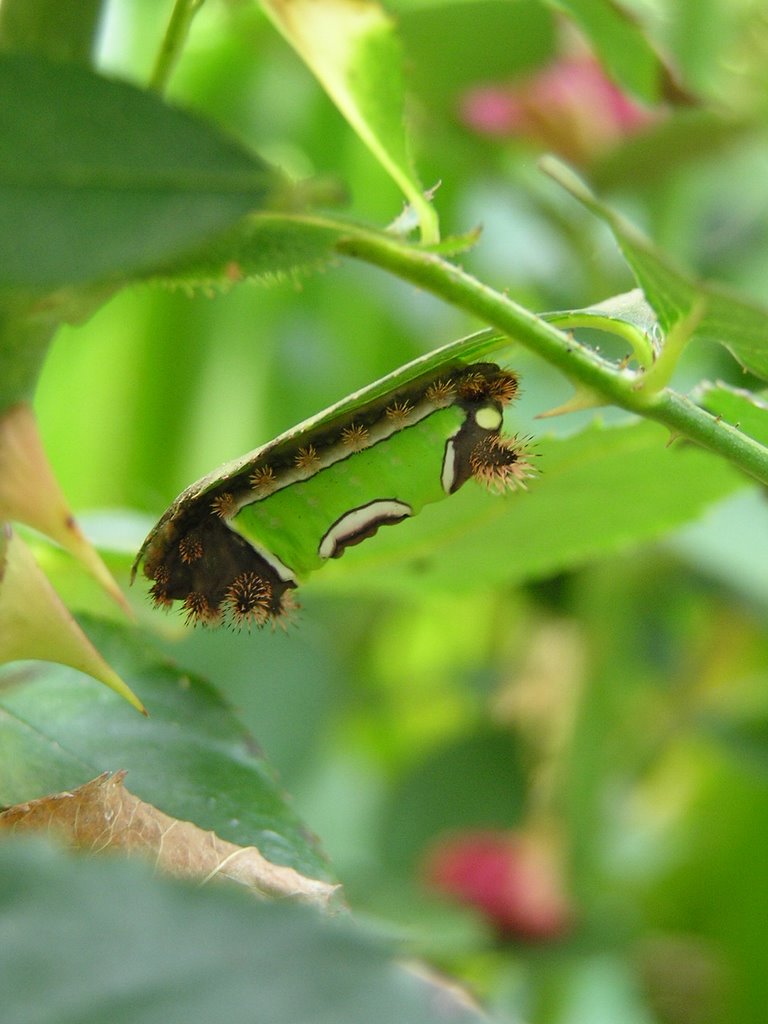
Last but not least, after noticing that one of my rose bushes was looking rather "eaten," I started looking closely and found two saddleback caterpillars hiding on the underside of nearby leaves. These funky looking guys are the larval form of a rather nondescript brown moth. If you see any of these guys, though, be careful. Those cute tufts of "hair" at either end of their bodies are actually stinging spines.


Everytime I go outside, I seem to notice something new or different. It makes it hard to stay inside!

Tuesday, June 13, 2006

Further Armadillo Troubles

I am discouraged this morning. Every day since my "Daily Rituals" post, I have done my morning walkabout and found uprootings and holes dug by an armadillo in the garden beds. Since we blocked off the holes under the fence, I have to assume that this unwelcome guest has taken up residence in the yard, although I have been unable to find his burrow so far.

On one hand, I can't blame him. We have water in the birdbaths, a ready supply of earthworms and other soil organisms, and plenty of bushy undergrowth to shelter his burrow. On the other hand, he's wreaking havoc on my mulch - bringing soil to the top that will put out the welcome mat for a whole variety of weeds - and uprooting at least a few plants almost nightly.

You would think that with FOUR dogs in the yard, at least one of them would make this garden a little less hospitable for him, but it doesn't seem to be working that way.

I've unblocked the holes under the fence and hope that he'll move on to greener pastures on his own. Otherwise this weekend, Prairiewolf and I are going to have to seriously search for his burrow and figure out how we're going to livetrap him and get him out of here. No other solution is, unfortunately, coming to mind.

Meanwhile, our drought is continuing. Just two miles away, they had a huge rain last week that soaked most of the city. And last night one of my in-town friends commented that she'd had rainshowers twice so far that day, probably compliments of Alberto. But we're still bone-dry out here in suburbia. I've had sprinklers going almost nonstop for over 2 weeks now. It's keeping the grass green and the plants from dying, but it's not the same as a good, soaking rain. I hate to see our water bill for this month.

On the other hand, at least we're not dealing with a hurricane. So far. So I'll try not to complain too loudly or too long.

Saturday, June 10, 2006

A Brief History of the Myth and Meaning of Gaia

Recently, a friend who has read this blog asked the question, "What does Gaia mean?" In one of those "Aha!" moments, I realized that many people may not know what I mean by naming this site "Gaia Garden."

So a quick explanation is in order.

For starters, in Greece, one of the earliest goddesses was Gaia, the Earth Mother (or Mother Earth, if you prefer). She was considered to be one of the founding goddesses, born of Chaos, and giving birth to the sky (Uranus) and the sea (Pontus), and sometimes, by some, to the mountains (Ourea). Without going into a great deal of detail, she was basically the original goddess, giving rise through her progeny to essentially the entire pantheon of Greek gods and goddesses. Eventually her progeny became more well known than she was.

Fast forward a LONG, LONG time (in human history) to the mid 1960's. An atmospheric scientist, James Lovelock, proposed that the Earth is a self-regulating organism. He called this "the Gaia hypothesis," after the old Greek concept of "Mother Earth." It took quite a few years and collaboration with Lynn Margulis, a biologist/microbiologist, but this hypothesis has now gained a fair amount of scientific credibility and generates a lot of scientific work in the field of ecological science. In short, now "the Gaia hypothesis" is often used as the more poetic name for current areas of science investigating Earth's homeostatic systems, or ways of maintaining its temperature, atmospheric mixture of gases, and other life-supporting systems.

In less scientifically rigorous ways, the concept of Gaia has come to symbolize the interconnectedness of life and the planet on which we live.

So in naming my site, "Gaia Garden," I'm trying to emphasize the concept of gardening by working WITH nature's processes, rather than by trying to "tame" those processes or "overcome" them. And in a rather idealistic way, I guess I'm trying to explore generally living in an "Earth-centered" way, at an "Earth-centered" pace too. Faster and busier hasn't necessarily proved to be happier or healthier or even more productive for many people. Maybe it's time we remember we're part of Earth, part of Gaia, and start honoring her and living by her guidelines.

Friday, June 09, 2006

Enriching Rituals

As I've gotten older, I've come to cherish the time and ability to enjoy certain daily rituals. Newness and adventure can be exciting and stimulating, but for relaxation, contentment, and the sheer enjoyment of being alive, give me these daily rituals anytime.

I'm not talking about mundane daily rituals like cleaning up the kitchen or brushing my teeth, I'm talking about the rituals that add richness to life. (I was going to include daily showers as mundane, but remembered that it doesn't take more than a day or two of having to go without one to realize what a wonderful daily luxury they really are! The trick there is remembering to be grateful for their simple pleasure.)

When I'm fortunate, I've got three sets of daily rituals that currently punctuate my days.

The first ritual of the day is in the early morning, when I do a leisurely walkabout of the garden, with a cup of coffee in my hand. As I walk, I visit every plant and give it at least a cursory once-over to see if it needs care of any sort. This is when I decide that I really do need to spend some time weeding, or that the hydrangeas desperately need water, or that it's past time to prune the asters back, or that the garden is looking great and I don't need to do anything much except enjoy it. This morning's revelation was that the *#%@!&#* armadilloes got back in the yard last night and, if I didn't want to lose a lot of expensive plants, I'd better repair their damage immediately and block the drainage holes again. Unfortunately, they completely uprooted one of my last 3 dwarf cleomes and, with the heat, I don't think it's going to recover.

The second ritual of the day is in the late afternoon or early evening, when I grab my beverage of choice and wander back to the "Outback" to sit and veg or sit and cogitate. Sometimes I do this one by myself while waiting for Prairiewolf to get home, and sometimes I do it with Prairiewolf, if he has gotten home at a reasonable hour and is so inclined. Mainly this is a time for relaxing and letting go of the day's concerns, while watching the birds forage, the leaves dance in the breeze, and the light grow soft and dim. Mosquitoes usually signal the end of this magical time.

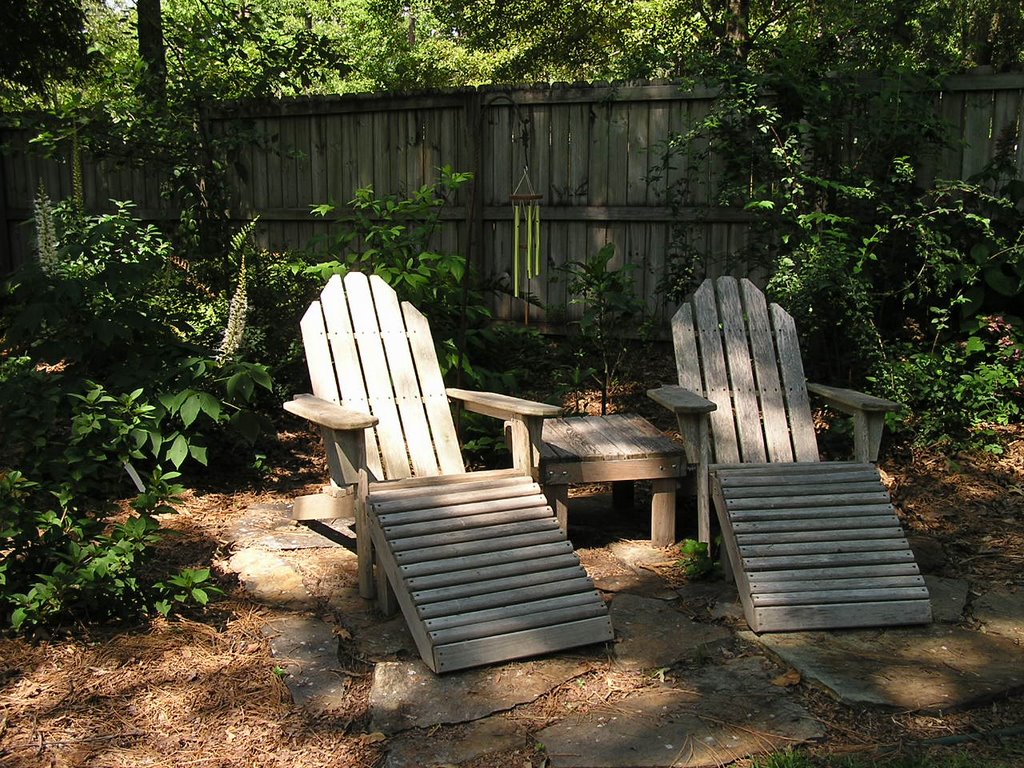
The photo here is of the "Outback", complete with my new addition of windchimes, a celebration of age and friendship from our dear friends Flip and Shelley. The chimes are tuned to the notes of the Chicago Jazz Festival, and form a link with far-off friends and places. Note, too, the bright white exclamation points of the bottlebrush buckeye (Aesculus parviflora) blooms, shining beside the Adirondack chairs. Bottlebrush buckeye is one of Michael Dirr's favorite yard shrubs and, as this one gets bigger, I can really see why. When it's in bloom, it lifts my spirit everytime I look at it.

The last enriching ritual of the day occurs as we get into bed for the night. Our cuddly, orange fluffball of a cat suddenly gets a wild, demon-eyed look and leaps upon any movement under the covers, fully intent upon destroying the enemy obviously lurking there. (Needless to say, we keep a heavy quilt on the bed these days!) T.J. stalks and pounces for several minutes, until he's sure that he's made the area safe for the night, then calmly proceeds to curl up for a good night's rest. Not to be left out, our big German Shepherd pup lays his huge head on the bed near our pillows, sincerely requesting a serious and lengthy good-night petting, before he, too, curls up beside us on the floor and goes to sleep.

These routines cost little except time, but how precious they are to me and how lucky I am to be able to enjoy them. Sometimes I think that we, as Americans, get so caught up in making money for more "things" that we lose sight of what really makes us happy.